Javascript

Showing posts with label journal. Show all posts

Monday, February 20, 2012

GDP?

Internet Poster's Question:
I am not a economist, but just a simple question: What does India really make to warrant its economic growth? Only thing that I have experienced is the frustrating call center service from India. Don't think India really export any agriculture, natural resources, or anything else high tech. So really, what is India doing to generate wealth?


My Answer:
GDP does not equal the trade imbalance, or even exports. It is a measure of goods & services provided. Keep in mind that Earth does not export anything to Mars, Pluto or other planets, and yet you would agree that us Earthlings have become wealthier from 4000BC til present day. Earthlings enjoy televisions, internet, cellphones, and all the comforts we know despite never exporting to Mars and Pluto. That is because wealth doesn't merely come from exporting, it comes from producing. India has a large domestic industry, producing a multitude of goods, as well as various services like tailors, spas, restaurants, etc. to a population that equals 1.2 Billion people, the same as Earth's entire population in 1850.

Is India self-sufficient? No. It lacks one key resource: oil, which is by and far India's largest import. The largest export industries for India are textiles, agriculture, steel, automobiles, pharmaceuticals, and the smallest of its exports are its IT related services like call centers and software. Will India improve its exports? Yes, slowly. Why does India have tiny exports? Part of it is that India did not open its economy until the early 1990s; China, by contrast, opened its economy in the late 1970s / early 1980s as part of Nixon's ping-pong diplomacy. A closed economy does not trade very much with outside economies, usually achieved with high tariffs to discourage trade, and restrictive rules regarding foreigners opening shop in the country.

Why were China and India once closed economies? Security. A closed economy is immune from sanctions and other trading decisions of a foreign market. An open economy can become (dangerously) reliant on some key component, say, rubber, that can be turned off by the foreign supplier at any time, or used to extort the fledgling nation. During WW2, the allies stopped trading with Germany, and Germany suddenly lost key items like rubber and helium. This led to them trying to use hydrogen instead of helium on their airships, and that led to the Hindenburg fire. Also, foreign companies can engage in hostile takeovers of domestic companies, or product dumping, and this also leads to a security problem. For example, Domino's Pizza in the U.S. was known to sell a large pizza for $5 in a market that ordinarily charged $12, a ridiculously low price that lost them money; however, this ensured all competing pizzerias in the area went out of business, after which Domino's Pizza would raise their prices to $20. For a fledgling nation with small companies, the potential for a larger foreign company to use this practice was a threat.

Why did they open their economy? Trade imbalance. Despite being a closed economy, certain items, like oil, needed to be imported. These imports need to be paid in a currency the seller desires. Oil is sold in U.S. dollars, and the only way countries like India and China can acquire U.S. dollars is by (i) exporting, (ii) foreign direct investment (FDIs), or (iii) borrowing. Borrowing only delays the problem, since if they borrow U.S. dollars, they owe more U.S. dollars at a later date. FDIs are when, say, an American company wants to create an Indian subsidiary. All the Indian construction workers to erect the offices, employees, and local computers and other goods, need to be paid for in rupees, the local Indian currency. The American company exchanges some of its U.S. dollars for Indian rupees to achieve this in order to invest rupees into their Indian subsidiary. This currency exchange leaves India with some U.S. dollars and the American company with Indian rupees. India can then spend those U.S. dollars to buy oil. Exports are the simplest to explain: Indian companies sell some item to the consumers in the U.S., and are paid U.S. dollars. The U.S. is actually a really bad exporter, as our trade deficit shows, but the U.S. dollar can be spent to buy oil, which is by and far the most valuable product sold for U.S. dollars.

China actually has a problem in that it has too much U.S. currency. How on earth can you have too much? Because U.S. currency can only be spent in certain ways, such as buying oil, and China acquires more U.S. dollars each year than its need to buy oil. The excess money it then re-invests into U.S. treasuries, earning interest, since it can't spend it. The U.S. treasury interest is only 5% whereas China's domestic market is growing at 14%, so it would much rather invest that money for higher growth than 5%, but can't.

This is also why the world watches with bated breath as several oil-producing nations have been grumbling about the weakening U.S. dollar and contemplate selling oil for other items, like a basket of currencies. Iran, under recent trade sanctions by the U.S. and Europe, is rumored to be in negotiations to sell oil for Chinese yuan. If oil is no longer U.S. dollar denominated, it radically changes the global trade dynamics, since much of the value of the U.S. dollar is in buying this key commodity. It is also why the U.S. has such huge vested interest in the middle-east.

I hope that helps give an introduction to world economics and currencies.

Thursday, November 24, 2011

Asteroids


Internet Poster's Question:
I understand (drag etc) why the asteroid would disintegrate, but that is something different from actually exploding which, to me at least, implies that there is some kind of internal energy reserve which is released causing the asteroid to fragment violently from the inside. This is different from breaking up due to external forces (equivalent to the difference between how a bomb exlodes on hitting the ground and how a china teapot disintegrates on hitting the ground).

If I hit the water at 100 miles an hour I would, indeed, splatter quite unhappily, but I would not actually explode.

The Siberian example given by the speaker features an asteroid actively exploding, not just burning up. How does that happen?


My Answer:

The explosion is not a chemical explosion but a pressure-wave induced explosion. Take a look at this high-speed camera footage of a bullet going through an apple and a banana:


Inside the apple and banana, if the bullet were traveling slowly, it would just enter and exit leaving a hole-shaped burrow, much like slowly jabbing a pencil through chocolate cake. Because of the bullet's speed relative to the resistance of the medium, the bullet creates a pressure wave as it passes through.

This space.com article talks some more about asteroids exploding in the atmosphere.

An explosion can be triggered by expanding gas, as with nuclear bombs that heat the air and cause it to expand, or with TNT which chemically combusts to create CO2 and O2 gases that expand from denser, solid matter (and heats the air since it's exothermic). But an explosion can be any shock wave moving outward from the center.

When an asteroid hits the hard rocky surface of the earth, an explosion occurs as the kinetic energy is transferred to the surrounding rock as shock wave energy. That's why a room-sized asteroid can leave a mile-wide crater.

Similarly, if an asteroid is moving fast enough, the atmosphere will seem "hard" enough for much of its kinetic energy to be converted into shock wave energy (and heat from friction). When a smooth asteroid fractures and breaks off into numerous jagged non-aerodynamically shaped objects, further shock waves are created as these non-aerodynamic objects suddenly transfer even more kinetic energy into shock wave energy.

P.S. Regarding your teapot v bomb analogy: If your teapot were moving at 3,000m/s, it'd have the explosive power of a kilogram of TNT (4.1 megajoules). Remember, kinetic energy = 0.5mv^2, so something moving 100 times faster has 10,000 times the energy.

Friday, August 26, 2011

parallax

I was reading a certain xkcd comic talking about how large the clouds in the sky are and yet how difficult it is for us as humans to recognize their size. In the comic, the feat was accomplished through a marvelous use of technology, utilizing HD cameras kept 100 feet apart to achieve the depth perception needed to appreciate the true scale of these giants floating above us.

Well, that started cranking some of my now aged and beleaguered neurons into remembering an epiphany I had as a small child.

I was four years old and it was my first night out, literally. I had until then never experienced the night's sky, the stars, or the moon in all their splendor for any more than a glimpse, courtesy of getting tucked into bed each night. Well, this particular night was different; I was ushered into a car and, as per usual, wasn't told anything. Not being told anything actually had its advantages -- it meant I grew savvy at eavesdropping, though listening at that age generally led to more confusion than clarity. From bits of conversation, I gleaned that this was a long road trip. I disliked confined spaces, and I especially disliked confined spaces that so nauseatingly hurtled down the monotonous roads.

It was late, I was tired, but I was too excited to sleep. The night was so mysterious. My nose was practically pressed against the car window as I tried to soak in the strange new world. A bright glowing creature seemed to be hovering and following us, though. At first I wondered if this was some new insect or animal I hadn't known. None of the adults seemed to pay it any heed. It behaved very strangely for an insect, though. It seemed to follow and keep pace however fast we went, yet if we stopped, so did it and it seemed to keep its distance. It didn't seem like an insect; if it were interested, why did it not fly straight into the car? If it were not interested, why did it follow? Why did it not chase any other cars; why was it fixated on us? Moreover, insects fly forward, and thus would chase us from behind; this creature seemed just as content to fly sideways, hovering outside my side window. Then, something strange happened; we turned at an intersection and this creature rather than hovering to our side was hovering in front of us! This was either some devilishly clever creature trying to play tricks on me, or, as was made increasingly likely as we turned at more intersections, it was a fixture in the sky!

I marveled at it. It seemed so near and tangible like a firefly but now so very distant. I trained my gaze to probe it, to study it. It was the most inspiring object I had seen in that short little life I led. After some time we meandered through the small streets and intersections and hit a large, straight, road. The glowing orb was still outside. The car picked up speed, the pavement whizzed by in a blur, the grass across the shoulder of the road sped by as well. The trees in a distance danced along, and even the faint outlines of mountains in the extreme distance crept. The glowing ball stood still -- it stood perfectly still! This was astonishing to me. A tree was large, and a mountain gigantic; what did that say about this glowing ball? Well, it was no ball at all, it was a planet!

And for the next four years I believed the moon was the largest object in the universe, bigger than Earth or anything else that had ever existed.

Tuesday, May 03, 2011

Patriarchy, Patrilineality, and Primogeniture

With movies such as the King's Speech recently out on DVD, and the media showering attention at the wedding of a bald bloke named Willy and his air hostess bride Katy, one can't help but be cognizant of the English hereditary system.

In my case, I was additionally reminiscent of conversations I had in college regarding the distinctions between the English and French systems of heredity. The English system confers all status and privilege to the eldest male born; by contrast, the French system distributed status and privilege among all male born. Both systems employed patriarchy and patrilineality, but only the English system additionally employed primogeniture. It seems like an inconsequential difference, but, as with mathematical fractals and chaos, any iterative rule-based system takes subtle deviations and manifests them into mammoth ones.

With the English and French rules of heredity, the English fiefdoms were never divided upon inheritance, whereas the French fiefdoms were continually divided and subdivided leaving a patchwork of ineffective plots of land ultimately conquered by another, not to mention the severe inflation French titles underwent as a result. This ultimately led to the French lords losing their grasp on power, as there were simply too many of them trying to uphold the standard of living meant for a much smaller group of their ancestors.

Well, my train of thought continued along this line, and yesterday I pondered, is there an even better iterative rule-based system for consolidating power? I envisioned the Medieval society, so it had to conform to patriarchy and patrilineality. However, I decided to bend the definition of patrilineality to non-contiguous patrilineality. That is, instead of a father bequeathing to his eldest son, let him bequeath to his eldest grandson. Seems like a subtle difference, doesn't it? But, as was demonstrated earlier, subtle differences in the rules can lead to large scale differences in impact.

Let's play it out, shall we? Suppose a man from the Montague family and a woman from the Capulet family form a union. If their son is the eldest among all his male cousins, on his Montague side as well as his Capulet side, then he would be twice-inherited, creating a merged Montague-Capulet colossus!

If the English system proved superior to the French system because estates were preserved rather than divided across inheritance, this new hypothetical system may have proven even more potent in this Medieval society by actually consolidating estates across inheritance. Noble families often intermarried to form alliances, but under the proposed hereditary system, you wouldn't get a mere alliance, but an actual consolidation of two families' estates into a single heir.

In fact, this phenomenon did occasionally happen in English noble society, but more by accident than by systematic forethought. Every so often, a couple was left with no male heirs, and in such cases their son-in-law or grandson could become twice-inherited. This happened with rarity, however, and was generally avoided because the maternal grandfather had the unenvious distinction of generally not being accorded by English society any influential role over either his son-in-law or his matrilineal grandson. In fact, much of the fortune in such circumstances was afforded to charity. By contrast, a hereditary system that specifically inherited across a more removed relation — from a grandfather to his eldest grandson — would confer far greater influence to such a grandfather over such a grandson.

Monday, July 26, 2010

media hype and bell's theorem

So, I found the following e-mail dated 2007-08-24, in which I replied to an e-mail forward titled "FW: We Have Broken The Speed Of Light". The forward was regarding physicists from the University of Koblenz demonstrating quantum-entanglement, but the reporter chose to refer to that as "We Have Broken The Speed Of Light".


It's just a misleading headline, and the German scientists have done nothing new. The news agencies are renowned for pulling this sort of stuff -- ignoring scientific progress which inches along like a slug on the pavement, and then after decades of ignoring this, some news agency realizes that the slug has moved far enough from where the public was last informed it was, and the agency now declares this a "leap" in scientific understanding with a sensationally misleading headline and complete misunderstanding of the fundamentals. Unfortunately, most people do not grasp quantum mechanics and so any reporter can rise to fame with whatever sort of babble he writes.

The public would be more skeptical if, for example, the reporter claimed that the new Toyota manages to draw their new cars with 2,000 actual horses. That's not what a horsepower is, and people know that. We know that horsepower is a unit of force approximately equal to the output of one horse. This is important because the output of one horse is not the same thing as a horse, because one is a unit of energy per distance (force) that can be produced by a reasonably small device, and the other is an equestrian creature that needs to be fed and when in quantities exceeding twenty will occupy all lanes of a typical highway and would struggle to fit inside the average consumer's garage.

Physics isn't the only realm where "new"s is really "old"s repackaged under the mantra "if you haven't seen it, it's new to you." Remember 9/10/2001? The summer was all about shark attacks, and every news agency jumped on that band wagon because shark attacks went un-reported so long that it became new and terrifying. Of course, the little known fact was that 2001 witnessed a below average incidence of annual deaths due to sharks. That's right, a year with fewer shark attacks than usual fueled a media frenzy over each and every shark attack.

Take, for example, these headlines:

Why Can't We Be Friends? A horrific attack raises old fears, but new research is revealing surprising keys to shark behavior
(TIME magazine, cover, 2001)
A Scary Jump in Shark Attacks...Could Threaten the Sharks (Businessweek, April 23, 2001)
Expert confirms surfer was bitten by shark (CNN, July 20, 2001)
Boy dies after shark attack (CNN, Sept 2, 2001)
Man killed in N.C. shark attack; woman hurt (CNN, Sept 3, 2001)

Any many more..

Contrast that media hype with academia trying to bring people to their senses:

"GAINESVILLE, Florida, February 18, 2002 (ENS) - Despite the prevailing perception that 2001 was a banner year for shark attacks, actual numbers were slightly down, a new University of Florida study shows." -- University of Florida (ufl.edu)

" 'Falling coconuts kill 150 people worldwide each year, 15 times the number of fatalities attributable to sharks,' said George Burgess, Director of the University of Florida's International Shark Attack File and a noted shark researcher." -- Daily University Science News (unisci.com) May 23, 2002

Dubious Data Award 2001: "The frenzy was remarkable. According to the NEXIS database, there were a mere 58 stories about shark attacks in the US print media in June. This increased tenfold in July to 592, and it rose again in August to 684. September was the month the story would have consumed all others, with 624 entries up to and including September 11. The advent of another dangerous but unseen villain stopped all that. ... During the 1990s, when only five people were killed by sharks, 28 children were killed by falling TV sets. The Times editorial mentioned above concluded from our data that, loosely speaking, 'watching Jaws on TV is more dangerous than swimming in the Pacific.' " (stats.org, Jan 1, 2002)

Right, so we've thoroughly exposed how most of these headlines are useless "old"s repacked with bad math and poor editorializing to shock you as "new"s. Why is the faster-than-light article misleading? Well, first, we need to delve into what speed is. Speed is distance per time. What is distance? One might answer "the distance between A and B is the length of a straight line between those points". But that's not quite right. A straight line is the definition of distance only in Cartesian space, but in other geometries where the straight line is sub-optimal (longer than the shortest path) or impossible (shorter than the shortest path), the length of a "straight line" is not the distance. So what is the distance? It's the length of the geodesic -- which is just a math term for the "shortest possible path". Aha! So now we're making progress - that means that I can travel at a speed (distance per time) slower than light but arrive sooner by reducing the distance! But of course we all knew that -- we find "short-cuts" to drive to work, often traveling on slow back-roads instead of fast superhighways yet still arriving quicker.

So how do these spatial short-cuts work? Well, there are all kinds of spatial short-cuts, because physicists have long since known that spacetime is heavily warped with many microfissures like quantum entanglements peppering the universe as well as with large fissures made by gravity wells such as blackholes, neutron stars, and wormholes. Physics of the very big (astrophysics) is only a looking glass, but physics of the very small (quantum mechanics) prescribes us experiments which are feasible to undertake. Specifically, the easiest way we can warp spacetime is through quantum entanglement -- which is far more than just a theory since Bell's paper shook the scientific community in 1964 with results which we will eventually get to in this email.

Okay, but what is quantum mechanics? Back in Einstein's day, it was centered on one notion: that a particle could be indeterminate -- that is, not only is its state unknown by you and me, but its state is unknown by even itself and the universe and, if we want to drag theology into this, God. Einstein famously exclaimed "God does not play dice!" to ridicule the notion of indeterminate states. Who were Einstein's intellectual nemeses? Neils Bohr and Werner Heisenberg, the two who came up with what became known as the Copenhagen interpretation while working together in Copenhagen, 1927. Essentially, Bohr and Heisenberg believed that sub-atomic particles were probabilistic and not deterministic. Einstein believed that probabilities were merely mathematical constructs on paper but actual things in the universe were deterministic.

Unlike a purely philosophical disagreement, this disagreement was scientific. If particles were determinate, they would behave like you would expect. If particles could be indeterminate, then some peculiar things can be done: particle X can be at A with 50% probability and at B with 50% probability -- which is a very different thing from saying X is at A 50% of the time and at B 50% of the time. To illustrate the difference, suppose I am (A) dialing my apartment number with my cell phone with 50% probability and I am (B) dialing my cell phone with my apartment number with 50% probability. There is just one (My Name – edited out), so you would expect either the apartment phone to ring or my cell phone to ring. However, that interpretation (Einstein's) would assume that (A) happens 50% of the time and (B) happens 50% of the time but never both. Under the Copenhagen interpretation, you would sometimes hear the apartment phone ring (A), you would sometimes hear the cell phone ring (B), and you would sometimes hear a busy signal (A+B)! That third possibility is highly important -- it means that both (A) and (B) occurred simultaneously and interacted with itself. How on earth can I get a busy signal by calling one of my phones from the other? You can see why there was a lot of debate - quantum mechanics does not sound reasonable. The scientific community was split.

All this is purely theoretical at the time (1920s and 1930s), but people were intrigued. So what is quantum entanglement? Well, "entanglement" was a term Schrodinger used during his debates with Einstein after the 1935 EPR paper (a paper written by Einstein, Podolsky and Rosen showing bizarre conclusions derived from quantum mechanics, a thinly veiled attempt at demonstrating the absurdity of such a view in a rational universe). Shortly put, these indeterminate states can be determinate by entangling with it. Schrodinger famously used his "cat in a box" thought experiment. We start with a single radioactive atom with a 1 week half-life, which means that it will decay in the first week with equal probability that it will not decay. Second, we add an execution machine which releases poisonous gas, triggered by alpha/beta emission (radioactive decay). Third, we add a living cat. Fourth, we seal them all in one impenetrable box. The cat's fate is entangled with the fate of the radioactive atom. If the atom decays, the cat dies, else the cat lives. However, because of the how the psi wave function works (the mathematical function calculating probabilities for indeterminate states), only the act of observing will collapse the wave function into a single determinate state, but for only the observer and no one else. The cat is observing the execution machine (through being alive or dead), and the execution machine is observing the radioactive atom (through being triggered or not). Therefore, the radioactive atom is in a determinate state for the machine and the cat. However, we the people on the outside are observing none of this, so the radioactive atom is in a quantum superposition of both states. Therefore, the cat also has entered quantum entanglement, because it observed the quantum particle yet was not itself observed. This means that the cat is also in quantum superposition, one involving both living and dead states. If we observe the radioactive atom, we make determinate the state of the cat; similarly, if we observe the cat first, then we make determinate the state of the radioactive atom. This is entanglement.

The Copenhagen interpretation says that such a thing is possible. The classical approach, endorsed by Einstein, says such a thing is impossible -- that it cannot possibly be that only when the box is opened the atom and cat decide to be either decayed and dead or non-decayed and alive. The classical approach suggests that this decision happened, that either it was fated that the atom decay and the cat die or it was fated that the atom not decay and the cat remain alive. The classical approach could never accept that a cat dead for one entire day could be decided now at the time of opening the box to have died yesterday. The present affecting the past is considered counterfactual, and this was the crux of the EPR paradox showing how quantum mechanics is in direct contradiction with a rational universe.

As reasonable as the classical interpretation is and as absurd as the Copenhagen interpretation, and quantum mechanics along with it, sounded, the mathematics was inescapable and particle physicists had known since the Thomas Young double-split experiment in 1801 that physics of the very-small behaves in absurd ways. While the rift within the scientific community lingered, exacerbated by Einstein's obstinacy at pursuing a feud with quantum mechanics, many bright minds and leaders of the community flocked toward quantum mechanics. In many ways, Einstein's opposition was a bit hypocritical. His own theory of special relativity, and later general relativity, battled against classical Newtonian physics, and the new theories of quantum mechanics did not jeopardize relativity -- in fact, quantum mechanics and the theory of relativity can coexist side by side perfectly without contradictions. The dispute was academic, it was abstract, it was about the philosophical nature of reality. It was, that is, until 1965 when Irish physicist John Bell released a paper which thundered through the community shaking classical beliefs down to their very core and proving beyond any doubt that the "rational universe" envisaged by classical notions was what was fake, rendering any classical notions of local realism illusory.

Specifically, Bell's theorem proved how local hidden variables cannot explain the phenomena observed at the quantum scale. It sounds like a benign statement, unless one realizes what local hidden variables are. In the example with Schrodinger's cat in a box, the classical approach would suggest that whether the atom decayed and the cat died was hidden, not indeterminate. Classical thinking states that this special impenetrable box merely hides what happened, but all the events still transpired and are not in an indeterminate state. Bell's theorem shows that however reasonable such classical thinking is, it is wrong, hidden local variables do not work. The theorem is simple, and involves setting up an apparatus to empirically verify how our universe isn't a rational universe, one which could be explained merely by local hidden variables.

The remainder of this e-mail is devoted to summarizing Bell's theorem:

Bell's theorem begins, if local realism is true, then there is no impact of a distant actor's actions when measuring a local particle's spin. The phenomenon where two particles under quantum entanglement can have perfect correlation when measured at identical angles (let X be this angle) is a phenomenon that can be explained under the model of local realism by employing local hidden variables, as follows: A deterministic mapping could be programmed into these entangled particles at the time they were entangled, which is feasible because at the time they were entangled they were proximate to each other. The deterministic mapping, call it m, would map an angle, from 0 to 360 degrees, to spin, -1 for counter-clockwise and +1 for clockwise. Therefore, even if these entangled particles are now apart by great distances, one actor measuring one of the particles at angle X would see a spin m(X) and a distant actor measuring the other particle at angle X would also see spin m(X). Since m is a local property carried by each particle, nothing non-local affects the measurement.

While local realism seems to work at explaining entanglement, Bell's theorem devises a situation where it fails. Let Q and Q' be two angles the distant actor can measure at, and R and R' be two angles the local actor can measure at. Therefore, we need concern ourselves with only a reduced m, one which doesn't handle 0 to 360 degrees but instead only four angles, Q, Q', R, and R'. Since m is deterministic, there are only 16 possible mappings it could be -- e.g. m(Q,Q',R,R') could be (1,1,1,1) or (1,1,1,-1) or (1,-1,-1,1) et cetera. Let M be the set of these 16 possible mappings. Let s be the spin the local actor observes and let t be the spin the remote actor observes. We can decompose E[s*t|Q,R], the expected value for the product s*t for when angles Q and R are chosen but m is free to be anything in M, into "sum p(m)*m(Q)*m(R) for all m in M", where p(m) is the probability of m occurring, which may be 1/16 if all 16 mappings in M are equally likely to occur, but we place no such restriction on the distribution.

Next, let W = E[s*t|Q,R] + E[s*t|Q,R'] + E[s*t|Q',R] - E[s*t|Q',R'], which decomposes into "sum p(m)*(m(Q)*m(R) + m(Q)*m(R') + m(Q')*m(R) - m(Q')*m(R')) for all m in M". We know that any expression S of the form qr + qr' + q'r - q'r', where q, q', r, and r' are real numbers in the closed interval [-1, 1], must be a real number in the closed interval [-2,2] due to algebra. (Explanation: qr + qr' + q'r - q'r' is linear in all four variables, in other words, the partial derivative of S with respect to any single variable is an expression lacking that same variable; so, S must take on its maximum and minimum values at the corners of its domain. Thus, some integer inputs q, q', r and r' each in { -1 , +1 } must yield the expression's min/max bounds. Either employing further algebra or applying brute-force on all the 16 possible integer inputs, we find -2 and 2 are the bounds.) Therefore, W is bounded by "sum p(m)*Sm for all m in M" where each S is an unknown in the interval [-2,2]. Therefore, W is in the interval [-2,2]. (Explanation: p(m) are weights that sum to 1, and a weighted average of values in an interval must yield a result in the same interval.) This inequality, -2 ≤ E[s*t|Q,R] + E[s*t|Q,R'] + E[s*t|Q',R] - E[s*t|Q',R'] ≤ 2, is the BCHSH inequality, which gives us a formal mathematical constraint when believing spin is determined by local hidden variables and not a distant actor.

Bell's theorem concludes, this time finding a constraint for W using quantum theories. The wave function in quantum mechanics simplifies E[s*t|A,B] to cos(2B-2A) for any real angles A and B. By letting Q = 2pi/8, Q′ = 0, R = pi/8, and R′ = 3pi/8, then W simplifies to cos(-pi/4) + cos(pi/4) + cos(pi/4) - cos(3pi/4), which is approx. 0.707 + 0.707 + 0.707 - (-0.707) = 4 * 0.707 = 2.828, thereby violating BCHSH. This is perfect, it places contradictory mathematical constraints, between [-2,2] with local hidden variables and 2.828 with the wave function, on W.

Due to the law of large numbers, the running average, obtained by repeatedly rerunning experiments, rapidly converges to the expected value, meaning we can empirically measure E[s*t|A,B] for any angles A and B at arbitrarily high confidence levels. Current empirical evidence shows with high statistical confidence that the expected value is above 2.7, easily violating BCHSH and approaching 2.828 predicted by the wave function.


There is a caveat about Bell's theorem I had omitted from the above e-mail. A hidden variable could exist at the time of the universe's creation. Let's call this variable U, for universal simulator. If everything in the universe were proximate at this time of creation, then all particles may share this variable U, and any new particles may copy U whenever it comes across a U-carrying particle. Thus, all particles with high statistical confidence are U-carriers. Now, since U contains all information from the time of the universe's creation, then, if everything in our universe is pre-determined, we can know seemingly non-local information by merely querying the local hidden variable U, which, as a universal simulator, knows everything about our universe if events are pre-determined from initial conditions. Therefore, two entangled particles may "know" about each other from U and conspire to yield strange results.

Rather than a gaping loophole, this is a minor caveat because such a universe that conspires so maliciously to deceive us is akin to the ones imagined by philosophers of antiquity when they questioned whether the universe may have arisen only now, with every particle perfectly in place with the right momentum to trick us into believing there was any history at all when none existed. Were such celestial malice present, it would be impregnable to philosophy, science, and studies in general. Therefore, by reductio ad absurdum, if we wish to study, we must study the alternative, the scenario in which the universe is not so malicious.

Saturday, February 07, 2009

Re: Imminent U.S. Attack On Iran?

Continuing on the theme of dredging up old emails in lieu of posting anything new, I found this reply I gave to someone who had forwarded to me a widely circulating email. The circular suggested an imminent U.S. attack on Iran while hypothesizing false-flag operations would precipitate the event and referencing a film called "Terrorstorm". She asked what I thought, if investments need to be protected, and if I had heard of the film. My reply, posted Wed, Nov 29, 2006 at 1:14PM is as follows:


It's unlikely that anything large-scale is imminent. Moreover, it's extremely dubious that any administration can plan and execute self-injury to its own naval vessel.

This is not to say that were accidental injury to occur that the event would not be propagandized mercilessly in an opportunistic manner. The Spanish-American war of 1898 precipitated in large part due to the sinking of the USS Maine on February 15, 1898. While the cause of losing the vessel was deemed inconclusive both by independent experts of that time and by those today, the U.S. Govt. under strained relations with Spain decided to spin the event as a deliberate attack by Spain. The rest is history. Current theories as to what caused the USS Maine to sink agree that the ammunition magazines in the ship exploded, destroying the vessel. The theories then diverge from there, one believing the vessel detonated a Spanish mine and that ignited the magazines and another believing the high-temperatures of the coal-engine ignited the magazines. Despite the theories, it is widely agreed that Spain desperately wanted to avoid any confrontation with the U.S. because it was more than aware of its naval inferiority to the newly industrialized U.S. Why a nation aware of the certain defeat it would suffer if engaged in a war with the U.S. would precipitate one stands against reason; yet, in 1898 the U.S. Govt. played Spain as the aggressor and emanated its views across all distribution channels.

One thing to note, however, is that the U.S. Govt would never explicitly execute injury to one of its own vessels because the gravity of that act would be so earth-shattering that it could simply never be kept under wraps. Too many individuals would need to be involved and the risk exposure too high. Passive negligence is often the route to achieve casus belli, as some suspect Roosevelt employed with Pearl Harbor. The passive negligence Roosevelt is suspected of is in concealing and not relaying in a timely manner information pertaining to an imminent strike on Pearl Harbor, in the hopes that a successful Japanese strike, even if on a remote outpost in the Pacific, would engage the American public in furor. Of course, as witnessed with the slow information pipeline under the Clinton administration regarding the 1998 Pokhran-II tests, it seems reasonable that inefficiency and lack of readiness is caused by bureaucracy and not by malicious intent.

All that said, is an invasion of Iran imminent? The option of passive negligence is always available and it would inevitably lead to a confrontation of some kind with an enemy of the Govt.'s choosing, presumably Iran. However, I do not think our current administration would exercise such an option for two reasons.

The first reason is that the military command structure has built-in shortcuts to bypass sending every decision to Bush. If reinforcements or some other defensive precaution is needed, the military can carry out the needed tasks without involving Bush. The only time the president is necessary is in transforming intelligence provided by the CIA into action carried out by the military, and the president can choose to delay this process as some claim Roosevelt had. While the CIA may provide vital information which Bush has the ability to be passively negligent of, the strong presence of the U.S. military forces in the middle-east supply the military with a self-sufficient source of intelligence, effectively diminishing the utility of the CIA and removing opportunities for Bush to be negligent.

The second reason is that Bush's political capital is extremely low, both with allies as well as with ordinary folk, and I doubt he would successfully manage to convince everyone that stretching our military thinner than how extremely thin they are already stretched is a good idea.

Of course, it's likely that Ahmadinejad's advisers have made similar analyses and will try to push the boundaries of what the U.S. will allow them to do. This could spiral into brinkmanship. As of yet, there hasn't been any serious news of Iran testing the patience of the U.S. Without properly testing our reactions to various, minor infractions of internationally acceptable behavior under the current settings, Iran would not be able to triangulate a clear enough landscape of permissibility. Thus, even if they are aware that the landscape of permissibility has expanded due to an emaciated Whitehouse and depleted spare military power, they are in the dark as to the exact boundaries of this new permissive landscape. So long as they are uncertain what our reactions will be, Iran will not take any path of major consequence. Of course, I could be over-estimating Iran's prudence and they may decide that venturing into an unknown landscape is of high enough value to merit the risk.

Still, should investments be protected? Of course. But the advice is no different than it always has been: a well-balanced portfolio. Equity, currency baskets, funds, etc. I don't think anything in particular needs to be done whether or not we invade Iran. In the extreme case, the Govt. might issue higher-interest bonds to summon additional, immediate spending power for war-financing, thus reducing the price of existing bonds currently trading at lower yields and reducing the price of mediocre equity. The impact on stocks would not be as dire as one would think. If war-financing is conducted through the issuance of bonds, the US Dollar will weaken further, having two effects: firstly, better exports to Europe; secondly, cheaper labor and higher inflation. Traditionally, such devaluation has a positive effect on the economy because the mood of the consumer revolves around nominal wages. Thus, if they make 45,000 now and 52,000 next year, even if purchasing power has diminished, they tend to be giddy with joy at, yes, earning less, but receiving more currency units. This consumer confidence acts as a steroid, bolstering demand for almost every product, and helping stocks perform.

No, I haven't seen "Terrorstorm", but I now quickly googled and read reviews about it. It seems to be done with the theme that the govt manufactures a perpetual state-of-war in order to subdue domestic freedoms and attain maximum centralized power in order to perpetuate status quo and concentrate wealth to an elite class. It's a bit like the elected chancellor in Star Wars who manufactures an enemy to help receive enough votes to assume dictatorial control, legally, so as to manage the war effectively. "Terrorstorm" seems to be a mix of 1984 and Machiavelli's The Prince, done with a collage of news events. I think it assumes a higher degree of cohesion and capability than exists in reality, even if its assumption that greed and self-interest fuel most administrations is probably correct. However, even if most top-officials are corrupt and greedy, I think it would be disingenuous to assume that the corrupt and greedy are mostly top-officials. There are plenty of corrupt and greedy people acting purely on self-interest at all levels, from high-school dropouts at the lower rungs of the UCLA campus police to various mayors of small, insignificant towns.

It's not disconcerting that greed and corruption are pervasive, since that's an unfortunate reality; what is disconcerting is that the central govt., which is best suited to "policing the police" is instead distracted with imperialistic dreams abroad and is inattentive at home, or, worse, an enabler in granting an oversupply of power to domestic bureaus and state law-enforcement with little to no oversight. While the '60s showed a central govt. willing to act for civil liberties by stepping in with U.S. Marshals and other federal forces to ensure that black students were permitted into white schools in the South, despite opposition from the Southern governors and local police, it now no longer seems conceivable that the new central govt. would use forces to protect citizens against rogue police. The path currently taken seems to steal focus away from domestic abuse and onto foreign affairs, leaving local forces with a carte blanche in using newly conferred powers. With the evaporation of habeas corpus and other guarantees to prevent abuse, there's less and less apart from per-capita income that differentiates the U.S. from a stereotypical non-democratic regime.

Sincerely,
(My name)

Thursday, February 05, 2009

Re: high school graduation speech

Walking down memory lane with my gmail archive, I found an interesting email I sent in response to Paul Graham's graduation speech. I had emailed him on Fri, Jan 21, 2005 at 3:57 PM, the following:


Hello Paul,

I hope you're not being inundated with slashdot readers writing their feedback. I'm certainly not lessening the effect by writing, but I feel I should write since I enjoyed reading your graduation speech and am as dismayed as you that it couldn't be delivered. I'm not in highschool anymore, but mentoring highschool students in my free time I know your advices and anecdotes to unveil reality are good ones. I've even forwarded your webpage to my younger cousins who themselves are in college but still very curious about life, the division between childhood and adulthood, and the "point of life" - to stay upwind as you put it.

Apart from my compliments, I also have a suggestion, which I'll get to after a short anecdote of my own. I was very mathematically inclined as a kid and delved into software more than most I knew. All along, I had only one friend whom I could learn from and he equally learned from me. Even my father who was a software developer was uninterested in the murkier topics of computer science theory, such as lambda calculus, frequency analysis, and feistel networks, as the practicing world cared more about programming libraries. Needless to say, it was a difficult journey to learn and a lonely one at that. I knew college would be better, but that's eons away when you're in eighth grade. I stumbled upon linux, open source, and a community working on things without monetary purpose nearing the end of my tenth grade. My first email communique outside of my highschool was to Andrew Tridgell, then the sole samba developer. I had my vague notions of tcp and udp and OS datagram frames but in one email response he clarified questions I would've spent the next year analyzing. Instantly, solitary learning where I learn from my mistakes like an ape became human learning where I stood on civilization learning the past mistakes of all. It was incredible, and I wish I hadn't had to have stumbled on that revelation.

I'm not saying open source is the answer to everyone's grade school intellectual doldrums, even if it was my answer; I'm saying that a useful community will inevitably exist outside college, and highschool students impatient for that college life can tap into it earlier. The key element is people. Most students, including both the academic ones trying to learn and the non-academic ones trying to be popular, will benefit from the idea that there are more people to know and learn from than those in their own school. I know of far too many students who never communicate in email or chat beyond their school classmates, and parents unfortunately find that comforting. The concept I couldn't grasp was how many 6 billion people are and yet how only a few dozen people would be interested in samba in 1995. As a ratio, it's astounding. However, these non-popular -- distinctly separate from the unpopular -- projects are bastions of clever lonely people, the perfect type for a student with little to offer besides attention and a lot to gain such as knowledge.

Ergo, my suggestion. I believe it would be highly useful to impress upon students how they should look beyond their region - that while their home town may be the only place in the world to know certain inside jokes and terms, there are things far grander in the world and fractious enough as to make the individual teams small, closeknit, and meaningful. While being trendy and knowing the latest, local, and popular things can make one feel good about oneself, the eclectic, esoteric, and historical things are longer lasting benefits which compound with themselves in value over time. To be eclectic, however, one cannot be content with what is provided. I was very distrusting of supposed quality, and knew the world contained a spectrum of quality far greater than I could contemplate. Far too many people cling to the first anchorman, reporter, or developer they meet if they're interested in that subject. I suggest exploring and discerning whom to emulate.

Being mindful of history is necessary in order to be eclectic. Old news tends to be overlooked, or be seen as unprofitable, making it somewhat immune from the noise of limelight seekers' premature ideas and from marketing propaganda. There's money in making software, not in writing a taxonomy of comparisons between, or meticulously documenting the concepts wielded by, different software. There are even taxonomies on taxonomies, each level becoming less popular and less profitable and taking longer to complete, thereby missing the slim window of public interest. However, by sitting in 1995 and reading tcp/ip lessons in 1994 about lessons from 1991 etc., dating back to the release of the cornell worm in 1970, one could learn a lot more than if one had only read some arbitrary book circa 1980 focusing purely on unproven and trendy '80s paradigms. I've given the following advice to many: we should look at the thirty year topics that are still alive today, even if barely, and trace the discussion back to their origins. By learning from the collective discussion, any contemporary incident can be seen through the lens of a learned person, yielding an amalgam of concepts surviving a darwinian massacre of preceding years' ideas. Once the lens has been shaped, it serves as a crude tool to craft finer tools. Apply that lens on another, more recent, incident, and repeat the process until you're looking at present day situations with an extremely well-pruned, eclectic corpus of knowledge with which to interpret anything you choose. This strategy works tremendously well at solving the problem of "noise" -- too much nonsense posing as quality work; and, interestingly, this same approach is taken by bayesian spam filtering.

Sorry for writing as much as I have - it was originally meant to be two or three short paragraphs. Pardon me for any typographical errors.

Cheers,
(My name)

Monday, March 10, 2008

astrology in the modern world

Below is my comment left on a Slashdot article regarding astrology. I was replying another poster who wrote something along the lines of "astrology is 100% wrong."
I think you meant to say astrology is 50% wrong, because if it were 100% wrong, it would have perfect anti-correlation (akin to scoring a perfect zero on a T/F test, and is just as difficult as scoring a perfect 100). If astrology is 50% wrong, it therefore is 50% right, and depending on the brain chemistry of the person, happy memories may get weighted more than unhappy memories, and therefore the weighted average of astrology working can be significantly higher than 50% - assuming a person who adheres to astrology derives happiness from when it is correct. In fact, for such a person whose happy memories are weighted more than unhappy memories, any catalyst for increased variance will lead to a happier life, including a coin-toss on whether to drive or walk to work. If astrology is a method to higher variance in the day to day experiences of its adherents, then so be it, it results in a happier life among those humans who benefit from high variance. Conversely, for those whose brain chemistry weights unhappy memories more than happy memories, lowered variance in day to day experience is the best method for maximizing happiness. The world needs both people, those who enjoy variance and are willing to eat a mysterious berry, be it a sweet, tasty berry or a bitter, sour berry, and those who hate variance and will only eat the safe, known berry. The risk-takers help society learn about new, tasty berries, and the risk-averse help society continue the species in case the berries were poisonous after all. Astrology is merely a shrub blooming random berries, half of which are sweet (+1 correlation), half of which are bitter (-1 correlation).

Tuesday, February 21, 2006

Unabridged, Unedited Conversation with YVXQXJJ

Monikers have been replaced with anagrams to protect the insane.


(21:32:55) PLZNYFGDJ: good grief

(21:52:04) YVXQXJJ: hi

(21:56:13) PLZNYFGDJ: how was your day

(21:57:14) YVXQXJJ: not bad. had the day off. we got customer approval on a project I worked all weekend on, so I told the boss I needed a day to refresh. how about you?

(21:57:24) YVXQXJJ: and what was the "good grief" for? :)

(21:57:58) PLZNYFGDJ: my exasperation over people who are illogical

(21:58:32) PLZNYFGDJ: logic just says you don't have a contradiction - it otherwise never places any constraints on how crazy your axioms can be

(21:59:22) PLZNYFGDJ: there are 4 types of people: crazy but logical - great! crazy but illogical - eek. sane but logical - yawn. sane but illogical - good grief

(22:00:11) YVXQXJJ: lol

(22:00:47) YVXQXJJ: my last ex - for all of a month - was the 2nd type.

(22:02:36) PLZNYFGDJ: I just IMed some woman who as far as I know is sane -- hasn't killed anyone yet.

(22:05:25) PLZNYFGDJ: But she got into some cockamamie claptrap about how we all have choice (she doesn't believe in determinism). Okay, I disagree with free-willists, but I enjoy their nonsense so long as they're using logic (and it's one of those philosophical stalemates where two good philosophers, one supporting free-will, one supporting determinism, can never find a fallacy in the other's statements)

(22:06:31) PLZNYFGDJ: So, I decided to egg her on by stating that, well, how come I'm not the prince of england, since I would've chosen to have been born as one

(22:07:34) PLZNYFGDJ: now, this is where she went from just screwball humorous (but otherwise logical) to illogical. She claims that she believes that we do decide whom we're born as, and at some level I wanted to be born as I was

(22:07:47) PLZNYFGDJ: now, on the surface of things, there's nothing illogical about what she siad

(22:08:18) PLZNYFGDJ: however, and I mentioned this to her, the consequences of what she said lend way to contradiction, disproving her premise. The consequences are as follows:

(22:08:48) PLZNYFGDJ: that means more spirits are deciding today to be born, since we have a global population of 7billion and growing

(22:10:03) PLZNYFGDJ: more spirits prefer to live impoverished lives with a 90% certainty of dying of starvation than to be born into a middle-class family (hooray for free-will!)

(22:11:57) PLZNYFGDJ: And, the clincher --- I can envision a hypothetical evil genius who controls trillions upon trillions of human embryos in a matrix, and can decide on the flip of a switch to fertilize them all and can decide just as easily in another flip of the switch to flush them into an abyss. It's against reason that trillions of spirits would decide at a single moment to infuse life into cells just to be flushed moments later.

(22:12:10) PLZNYFGDJ: Those are trillions of retarded spirits, in which case.

(22:13:55) YVXQXJJ: well, yes. most people are retarded.

(22:14:33) PLZNYFGDJ: bleh

(22:14:38) PLZNYFGDJ: defies logic

(22:14:49) PLZNYFGDJ: at least free-will philosophers employ logic

(22:15:20) PLZNYFGDJ: unlike people who "believe" and can't reason their way about why an even number plus an even number cannot be odd

(22:16:05) YVXQXJJ: philosophy - and philosophers - confuse me.

(22:16:17) PLZNYFGDJ: nah, they're fun folk

(22:16:27) YVXQXJJ: heh

(22:16:39) PLZNYFGDJ: they're basically mathematicans but with dumb/inconsequential axioms

(22:17:15) PLZNYFGDJ: but as any mathematican, logician, or philosopher will agree, whether or not an axiom is valid is only determined by whether or not you can infer a contradiction

(22:17:31) PLZNYFGDJ: so long as the system is consistent, you can have two separate systems with opposite axioms

(22:18:18) PLZNYFGDJ: e.g one system where the axiom says "God exists" and another where it says "No god exists" can be completely valid systems within which no contradiction can be inferred

(22:19:05) PLZNYFGDJ: mathematicians just pick more useful axioms, like "Given a Euclidean space (defined by 10axioms), a triangle's inner angles sum to 180"

(22:20:04) PLZNYFGDJ: a philosopher would pick, "suppose our bodies were merely mental projection with no tangible component, ..."

(22:20:39) YVXQXJJ: that's more or less it. one matters, the other does not.

(22:20:59) PLZNYFGDJ: In fact, philosophers so often picked insane axioms that instead of having to prove a contradiction, it was agreed upon that "reductio ad absurdum" was a valid enough counter-example to stop philosophizing over it

(22:21:34) PLZNYFGDJ: essentially, reductio ad absurdum states that if you prove that philosophy is unnecessary, then stop! Change your axiom before we philosophize again!

(22:21:52) YVXQXJJ: the world would cease functioning without math. philosophy... eh. some college profs would be out of a job, and some publishers would take a hit on their profits, but I'm otherwise not affected.

(22:22:03) PLZNYFGDJ: E.g. "what if the universe were created just this instant, with all its atoms and molecules arranged as they are and animated just now..."

(22:22:32) PLZNYFGDJ: that's a famous philosopher's dilemma -- there's no way to prove it's not true -- the universe may very well have been created just now!

(22:22:52) YVXQXJJ: my counter to that is they think too much.

(22:23:10) PLZNYFGDJ: However, if it has been created just now, then all this philosophizing we've been doing hasn't been philosophizing at all -- you and I were just created this instant with the illusion of having had a conversation

(22:23:16) PLZNYFGDJ: In which case, reductio ad absurdum!

(22:23:48) PLZNYFGDJ: Which is quite different from saying the axiom is wrong. Reductio ad absurdum does not say it's wrong -- it just says it's absurd! It's not worth talking about

(22:24:22) PLZNYFGDJ: If the very nature of talking is undermined under the axioms, then it's not worth talking anymore

(22:24:41) PLZNYFGDJ: beautiful, huh? Took thousands of years of bickering to come up with that one gem

(22:24:43) YVXQXJJ: right. my version of that is usually "shut up, quit talking. I don't have time for you, I have email accounts to fix and users to edumacate."

(22:25:56) PLZNYFGDJ: philosophy is a good exercise of logic, sort like bicycling is an exercise for the calves

(22:26:19) PLZNYFGDJ: but otherwise, yeah, it's inconsequential

(22:26:59) PLZNYFGDJ: exercising logic is pretty good though -- it helped usher in the age of enlightenment and all that

(22:28:30) YVXQXJJ: *nods* I've never been interested in philosophy or anything related. I think I've got logic down enough for what I do. I don't need to focus on it - if I don't have moments without logic, my mind breaks.

(22:31:09) PLZNYFGDJ: I need logic, not necessarily sanity, but definitely logic. For example, SG-1 adventures to new planets and everyone seems to speak english yet everyone seems to have mutually incomprehensible written language. Okay, bizarre, but it's not illogical. It's just an axiom of this fictional world, and it doesn't contradict anything! I like bizarre, as long as no contradictions arise

(22:32:31) YVXQXJJ: I just imagine that SGC somehow developed the universal translator and neglected to tell anyone about it.

(22:32:42) PLZNYFGDJ: heh

(22:33:14) PLZNYFGDJ: See, if the authors tried to explain why everyone spoke english (as you just did) rather than it being an axiom, then they might create some contradictions in all that complexity required to explain it.

(22:33:37) PLZNYFGDJ: For example, by trying to explain it with a universal translator, you just created several contradictions!

(22:34:01) PLZNYFGDJ: e.g. then why do they need Daniel Jackson to keep translating all these written works if they have a universal translator

(22:34:46) PLZNYFGDJ: a universal translator is illogical. Leaving it unanswered why they can verbally communicate is the best answer

(22:35:13) PLZNYFGDJ: trying to explain these things just creates inconsistency, and inconsistency is doom for any Sci-Fi would-be story

(22:36:30) YVXQXJJ: it can't translate written documents because the project went over-budget, so something had to be scrapped.

(22:36:54) PLZNYFGDJ: pfft. heh, see you're just adding more complexity and creating even more paradoxes!

(22:38:00) PLZNYFGDJ: Simplicity is key. Only add complexity when you're sure you've thought it through and it makes sense within the rules you define

(22:39:39) YVXQXJJ: something tells me you would hate certain Neil Gaiman novels.

(22:39:53) PLZNYFGDJ: you can define baseball, you can define chess, you can define any fair game and people will like to play with you -- if you create a game where the 2nd player always loses, you've made a pretty lousy game, and a system with a contradiction is a pretty lousy universe to set your fictional story in

(22:40:41) PLZNYFGDJ: it's broken. it's buggy. it's like m$ windows =)

(22:43:06) PLZNYFGDJ: fyi - when I said "the 2nd player always loses", I'm talking about the 'perfect-play', i.e. the players are both trying to win. You can obviously still win as a 2nd player in games where the 1st player must win under perfect play if the 1st player purposefully throws the game

(22:44:00) PLZNYFGDJ: And some bad sci-fi reads like a broken game where some player must win under perfect-player, but the characters are so dimwitted they still manage to bungle and almost-lose if not lose completely.

(22:44:39) PLZNYFGDJ: e.g. in Harry Potter, I near banged my head on a wall when Hermione used a time-travel device. WORST IDEA EVER. Bad, Bad JK Rowling!

(22:45:20) PLZNYFGDJ: I know she wanted to introduce the idea to little children, but she should've mentioned it as a device long ago that was destroyed because it was too powerful. Instead, she gives it to a 10th grader! Ugh

(22:46:23) PLZNYFGDJ: And then she quietly forgets about it. Dumbledore's dead? Time travel back and fix it! Something bad happened? Time travel back and fix it! See, the time-traveller is guaranteed to win under perfect-play! That kills the story.

(22:47:04) PLZNYFGDJ: proper time-travel is like how Sliders portrayed it, where you travel back to an alternate past, not your own past.

(22:48:04) PLZNYFGDJ: and that's also proper multiverse tiling according to Hawking-Penrose models of spacetime

(22:48:17) PLZNYFGDJ: anyhoot. I ranted

(22:48:39) PLZNYFGDJ: thanks for being the anonymous half-listener =)

(22:48:46) YVXQXJJ: lol.. no problem

Tuesday, September 06, 2005

Attending a Desi Wedding in Cincinnati

Labor day weekend went by rather well! Whenever any sort of long weekend creeps up, my family begins by expressing a warm, embracing intention to vacation somewhere. This wishful thinking must be quite taxing because my parents seem to move directly onto appeased inaction, bypassing the entire stage where one normally would book a flight and a room. This brilliant tactic of omission allows a vacation "planned" a month in advance to disintegrate into ether, leaving my family panic stricken the week of our supposed excursion and ultimately resigned to satiate our wanderlust another time. Despite this, somehow, maybe when the stars align, we get our act together and manage to go somewhere. This labor day weekend owes itself to one such cosmic arrangement. And, oh, what a weekend it was!


The Groom as White Knight

The Bride and Groom

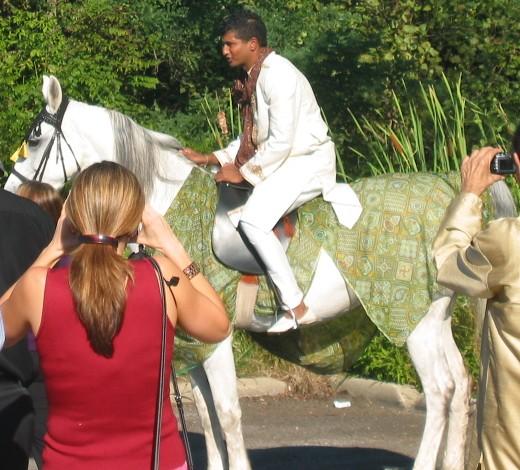
Weddings are always special occasions, but this desi wedding meant a three-day gala affair with the groom riding on a white stallion! In the picture to the right you can see the groom mounted on the steed. Truth be known, an equestrian trainer pulled it along, and it was for less than an hour, but still... a horse!

Since the groom is Tamilian and the bride is Gujarati, the wedding combined traditional North Indian style with traditional South Indian style. Hey, if it means more variety in sweets for the guests, I say combine away!

Unfortunately, owing to the paucity of Indian weddings I've attended, I'm not exactly sure which all aspects were Southern inspired and which all were Northern inspired. The ancillary use of the horse, by the way, is primarily a North Indian phenomenon, and may even be confined further to Gujarat. I know, I know, I'm a bad coconut with only a vague understanding of these things. I'm trying, right?


The photo to the left shows the general theme and the apparel worn. The guys in red on the rightside are mostly the groom's friends from Chicago. The girls in red saris are sisters of the bride. People are pumping their arms into the air as they dance to Hindi music in a procession behind which faint and gentle clacks of horseshoes emanate.

Arches and candles are among the more artistic items one can capture with a still; yet, some guy has the impeccable timing to get up and ruin my shot. Oh well.

I probably should cast a little of Cincinnati's limelight over on Kentucky since the latter is where most of the events actually took place. Barefaced about being a geography dunce, I never realized Cincinnati practically grows out from Ohio and into Kentucky! Makes me wonder, though, if Mr. Ed from the first photograph was ever in the Kentucky derby.

Tuesday, August 30, 2005

Acting with a Gracious Aussie, Politics at the Pool Table

I won! Wait, I won?

It takes quite a lot of skill to throw a game convincingly. The fact I'm still uncertain over whether the game was actually thrown is testament to my opponent's crafty generosity, if he really did let me win. I suspected something was awry when I narrowed his lead over me while he kept encountering a rash of difficulties with getting the 8-ball into any pocket, until that cathartic moment when, after a few of my own fumbling moments with the 8-ball, I won. Wow. At that moment, as strongly as I sensed victory was being handed to me, a feeling of redemption engulfed any other worries or misgivings I had. For an instant, lingering questions on the legitimacy of the victory evaporated, as did the tension of being down 0-4 games, a tension I grew so accustomed to as to fail to recognize how taut and clenched-fisted it had been keeping me. While the tension seemed permanently subsided, those lingering questions were less willing to go, coalescing into an anvil and thudding atop my head with the pestering realization that I need to think of how to respond beyond showcasing motionless stupor and disbelief.

What's the protocol, I wondered; do I sneak in a teaser about how he let me win? Should I thank him for the gracious gesture? Perhaps he would be offended if I garishly threw noise on a donation he so discretely made. Then again, I did still have to struggle - he certainly wouldn't have fiddled with that 8-ball long enough to embarrass himself. In fact, in addition to the onus of winning being on me, I had to endure the added pressure of potentially losing to someone playing on a five shot handicap. Yes.. yes.. the victory was well earned. Besides, I continued to reason, it would be sacrilegious of me to call his act an act when he expended considerable effort to make his loss credible. I decided to accept his donation; I played the intended part and offered a courteous "good game" with an appreciative smile and a nod. I instantly second-guessed myself, wondering if silently accepting someone's largesse would be considered tawdry, but, thankfully, the comforting return of relief from my opponent's starkly more relaxed look allayed any fear of misstep. He bought the act, or so I believe.

Tuesday, August 09, 2005

Robert Blackwill, Dictionaries, and p[a-z]*pot(ate|ent)

Despite a gleaming mention in the subject, Robert Blackwill has very little to do with this particular journal entry. In fact, he is merely part of the ambient noise surrounding a slippery word that tantalizingly evaded me. It's quite odd how, when focusing so intently on recollecting one thing, loosely related items emerge into thought and, though unsolicited, they emerge with unbridled clarity and brilliance.

I began explaining to a friend how I hate synonyms and prefer words which carry a larger concept - a purposeful word useful in reducing the amount of time to convey an idea. At that moment, I caught the shadow of a word which would be of prime example; unfortunately, anything more than the shadow eluded me. Lilipote? No, no. What was it? I struggled to think. I knew its definition is the use of a euphemism or understatement for emphasis. I started rattling off to my friend whatever I could think to see if the word would come to me. If two people are berated by an extremely mean officer, one can later use hyperbole to tell the other "that's the worst officer ever in history!" One can also use sarcasm to tell the other "he sure is a nice guy." One can also use a .. er .. lilipote to tell the other "he's not an extremely nice guy." Tragically, I was in the car without internet access. I asked my friend over the phone to google "lilipote" and although I was expecting no results, it was disheartening to be confronted with that reality. It did make for a decent segue into Lilliputs and from there the conversion meandered to other things of interest, such as the movie about a 40yr old male virgin, and away from this mess of grappling with quarter-life senility.

To ensure no one's spirits have risen in thinking this blog will delve into the interesting parts of that conversation, I should make clear that interesting movie-related discussion will never be in any blog I write. Interesting stories can easily be told to people, real-time; it's the uninteresting things which require the occasional straggler who resorts to reading blogs, having tired of hours of solitaire.exe and an additional hour of repeatedly dragging rectangles on her desktop to see icons highlight. Right, now that we've squared that away.. Once I arrived home and the conversation ended, I managed to remember 'litotes' was the word I likely was looking for, and a quick validation on the web vindicated my belated answer. Naturally, just before feeling the burden lifted, I remembered once knowing a word used in a many years old NY Times passage about then ambassador Robert Blackwill being autocratic and sinking his staff into depression by incessantly denigrating them. I knew the word meant something along the lines of being given authority or power by appointment; other than that, I only knew it began with something like "pen" and ended with something like "potate" or "potent" which is sadly insufficient to query a web dictionary, or a printed one for that matter.

Cursed word-based queries, grep would solve this in seconds, I muttered. Wait, yes, grep will solve this in seconds! After some longer than anticipated tar.gz hunting, I seemed to find numerous providers of the 1913 Webster's unabridged English dictionary, which has fortunately been released into public domain. With some tr, sed, and sort -u, I had a nice greppable txt file revealing 'plenipotentiary', carrying as a noun the meaning "a diplomatic agent, such as an ambassador, fully authorized to represent his or her government" and as an adjective "invested with or conferring full powers." Aha, excellent. If only there had been a web service to do this generally! Are you listening, Google? I seriously need a mind-augmenting persistent cache to prevent memory loss. As an aside, as if this whole posting wasn't a giant one, a month and a half ago I managed to utter "Al Grove" in place of "Carl Rove", seamlessly morphing him with a certain former vice president and presidential candidate I'll leave unnamed. Needless to say, that gaffe instantly clinched an unofficial debate victory for my heckling opponent.

Sunday, April 17, 2005

Jason and the Argonauts.. and The East Colchis Trading Co.

Some days back, I was watching one of those shows - the ones aired on History or Discovery or some other -y suffixed channel, the shows which somehow mesmerize me with enough intrigue that I try to extrapolate it onto other things or in some other way imbibe it into my own life’s fabric no matter how useless the content.

This particular show was analyzing the story of Jason, the epic Greek hero who, unlike every other epic hero, is endowed with little besides leading the Argonauts, crewmen so renowned the cast of Ocean’s Eleven could have been first-year acting majors.

The agenda of the show was to prove that Jason was not a mythical figure but an ambitious businessman, premising on the ancient Greeks’ use of allegories to tell the tale of businesses, trade routes, and mergers with fanciful hyperbole coalescing kingdoms, quests, and marriages into a riveting epic. The throne Jason sought from the cold, calculative Pelias was ownership of a trading company, and the quest for the Golden Fleece symbolized establishing a trade route from Thessaly in gold-scarce Greece to elementally rich Colchis in western Turkey where laborers used fleece to dredge up gold from turbid river water.

Even Medea, the sultry sorceress-princess of Colchis stolen away by an alluring Jason to later wed him, is theorized to be a symbol of a business contract between two corporate powers. I'm not sure how to interpret, however, how she in her later years turns out to be a scorned termagant, killing her children and an elderly Jason’s young, lithesome mistress.

While I’m sure our contemporary academes are over-crediting the epic writer with symbolism and other nuanced literary complexity, oh, how fun it would be if today’s newscasters delivered corporate news in the greek raconteurs' motif!

Sunday, April 10, 2005

philobabble

In the process of procuring for a friend a 1999 college paper of mine from my class on space-time, I decided to indulge myself in a waft of unintelligible writing from my other papers adjacently kept in six years of abeyance. I find it remarkable how I now find the jargon from philosophy so completely alien when years ago I swam in these terms and wrote about them freely. In my defense, Google presently seems to know of only 222 pages mentioning the Covering Law Model of Explanation and only 557 containing corpuscularity. I, however, have little excuse for forgetting Logical Positivism which appears in 76,900 pages in the Google corpus and even has its own wiki entry. Another esoteric term I almost never use and had nearly forgotten, supervenience has a healthy 30,200 hits with Google. Below is the text from my "Models of Explanation" class paper:
03/04/99 “Models of Explanation”
It could be argued that the most powerful tool we as intelligent beings posses is our capability to reason through logic in order to explain the happenings in our world. Ironically, it then becomes quite a task to explain such a tool since we will have to assume that our ability to deduce and explain is powerful enough to be self-applicable. For now, however, let us assume we can explain explanation. One model that seemingly does exactly that is the Covering Law Model of Explanation. In essence, this model uses a miscellany of reasoning taken from corpuscularity and positivism to disassemble our complex understanding of explanation into a series of simpler causal events that take on a true or false value in existence.

Applying this model, an explanation for why a vending machine gives soda would be broken into several mathematical tokens, each representing an ongoing event that influences the outcome in some way. A very rudimentary view would lead one to conclude that putting in seventy-five cents into the coin slot while the sodas are not empty and the power is on and the mechanical components are working would yield in the machine giving a soda. In any combination of events, a mathematical equation could take all the initial states and calculate a corresponding outcome. This very mathematical approach, however, would only be acceptable to a full-fledged determinist, or would otherwise be limited in its range of application, such as being applicable only to non-living things. Aside to this model of explanation’s dependence on determinism, its dependence on reduction again reduces its audience. Most probably, several other factors affect the mechanical condition of the vending machine and the number of sodas remaining as well as the power being on. Recursively, multiple factors would need to be monitored as potential variables in order to truly reduce any complex object. This infinitely required knowledge is often an argument against any form of corpuscularity.

A usual retort to any theoretical challenges imposed on a theory is providing empirical evidence in support of the theory; and, history comes in favor of the Covering Law Model of Explanation. Most Newtonian physicists and chemists often reduced complex real life occurrences into a simple matrix of variables, yielding a determined answer. Even in “An Explanation of Hunger,” a scientific paper written by Cannon and Washburn, the two authors sought to explain why humans get hungry, and in doing so fervently applied the Covering Law Model of Explanation. A similar endeavor to understanding hunger was conducted by another scientist prior to the attempt by Cannon and Washburn. With knowledge of the previous unsuccessful attempt at showing that hunger causes stomach contractions, Cannon and Washburn sought further meticulous analysis of the issue, with the starting intuition that perhaps stomach contractions cause hunger and not vice-versa.

By monitoring all the known macro-variables, which were referral of pain, chemicals secreted by the stomach, volume of substance in the stomach, and smooth muscle lining, Cannon and Washburn were able to deduce that the contraction of the smooth muscle lining that made up the stomach walls was what produced hunger. The very nature of the experiment focussing on components that could affect hunger shows the experimenters’ usage of reduction. The manner in which they manage to stay non-contradictory is to fix the recursive problem with reduction by having holistic macro-variables and using statistics instead of a deterministic framework. With this logic, whenever a person’s stomach walls contract, there exists a probability that the person will suffer from pangs. However, no attempt is made to recursively explain when these macro-variables will be true or when they will be false. This room for ambiguity serves, in part, to preserve the somewhat implicit nature of randomness of any complex system and the likelihood of supervenience being a more comprehensive model of the hierarchy in complexity than corpuscularity.

In fact, Mischel initially reasoned the holistic alternative that challenges the Covering Law Model of Explanation. The problems with both corpuscularity and determinism are corrected in Mischel’s holistic view whereby complex things are not treated as the sum of their individual components. Although classical Newtonian mechanics interlaces reduction throughout many of its theorems, it should be noted that most of the problems under scrutiny by these theorems were about non-living physical things in ideal conditions where no unknown variable influences the system. Because of the limited scope of simplified Newtonian physics, reduction works. However, for any truly natural event, and especially for any living being, the predictions based upon the micro-components would deviate from the actual results so quickly that no similarity between prediction and actuality would ever be noticed. Indeed, if a group of people were to enter a subway, the driving forces behind why each of them entered may differ vastly from the other. No generalization could ever be achieved unless a law were to be made for every person, essentially creating a rule for every exception.

In an excerpt from “The Origins of Intelligence of Children,” by Jean Piaget, the power that the Covering Law Model of Explanation can give is observed. Although, as stated earlier, reduction has its many problems that holism appears to resolve, science repeatedly maximizes the utilization of reduction for their benefit. Piaget initially tries to observe and record each invariant that could have any significant impact on his subjects, and then he goes about creating a system of simultaneous equations, essentially a matrix of all recorded variables. By seeing the deviance of output from a small initial change in one of the variables, and after several iterations of experimenting, a conclusion can be made about what each variable does with its normal environment. Again, empirically, conclusions appear to assimilate from the environment to predict accurately the actual end-results.

The philosophical issue pertinent now is whether empirical corroboration is enough to offset problems in the fundamental theories. The dichotomy between reliance on empirical proof and logical proof is of concern. A simplified analogy would be to drop a feather and a lead ball and show that objects do not undergo equal and unified acceleration due to gravity. This is utter nonsense, since all the empirical evidence would then corroborate with this invalid hypothesis unless someone were to remove every variable including air friction for a perfect experiment. Therefore, empirical evidence with many distracting outside influences cannot always be reliable, since induction has many of its own theoretical flaws.

In the case of Newtonian physicists and many scientists using reduction in order to simplify and then to conquer problems, the focus of study is always a simple organism, be it biological or inanimate. Firstly, a simple focus of study inherently supposes that the actions performed are deterministic, or pseudo-deterministic. A baby’s natural instinct for milk, as was studied by Piaget, would fall under this category of pseudo-determinism, because, although the baby is a living complex entity, the study is not about the baby. The focus of study, in this case, would be on the code programmed into its body, or natural instinct, which is not subject to free-will. If, however, the Covering Law Model of Explanation were to try to explain why a person decided to enter a subway, large clashes in philosophy would occur, since a free-willist would not accept any theory that assumes humans as deterministic. For studying human actions or any other complex indeterminant system, a holist’s approach, such as that of Mischel’s, would be necessary, where supervenience not corpuscularity would be the underlying axiom.

Another freshman-year paper worth reposting is one titled "Reductionist's Belief in the Observation Basis". I cannot recall another time in the six years following when I have alluded to Hilbert or Gödel. My lack of doing so is perhaps indication that, unless I make a conscientious effort otherwise, my most enlightened years are behind me. In any case, below is the text from that elliptical class paper of mine:
03/17/99 “Reductionist’s Belief in the Observation Basis”
Straining to cope with the sudden burst of information rushing through time, with information pleading to be processed as quickly as the next information can take its place, a newborn has the universe materialize around itself. With no earthly law other than the apriori knowledge of motion, everything else, every nuance of our meticulous training and thinking, the foundation of all modern understanding, is left as an unprecedented event for the distant future. The future of this newly created realm, however, remains an unintelligible concept as elusive to decipher as the creation of the present. The self encompasses everything, and the universe appears as merely an extension of the limbs. Indeed, nothing starts of as apriori knowledge and all accumulated knowledge may only be a gaudy tower of Lego blocks where the corpuscles of reality are deceptive inferences of the sensations.

Logical positivism has a long life, spotted with illness, yet healthy for the most part; its longevity allows it to remain an incessantly recurring philosophical view. However, if the universe is a game as mathematics was thought to be by Hilbert, could there be some savior, an anti-positivist counterpart to Gödel? Perhaps, through this game we play, where we role-play in our most sentient dream, we may discover truths of the underlying reality, assuming there is one. Therefore, with the needed assumptions, truths can be derived merely from observation. Furthermore, although a newborn may appear to learn holistically, as the universe takes on a more rigid and developed form, cognitive thinking sharpens like a lens focussing. This sharpening of cognitive thought from the sensory data can be seen as one’s adopting of reductionism. Although the focussed picture may vary in appearance depending on the defined corpuscle, the re-blurred images will all be identical again. Essentially, from a functionalist’s standpoint, the macroscopic object reconstituted solely from its corpuscles will always be the same regardless of what its corpuscles are. As long as the observation basis continues to be used, there will be inherent truths discovered through reductionism, and these inherent truths, holistic in nature, will correlate in a non-contradictory manner.

This weekend has seen me mired in nostalgia. Yesterday, I wanted to immerse myself in '80s video games, loading the save files from my 386. Alas, it was not to be had. I found my 386 hidden in the study room but could not locate its power cables or monitor.

Revisiting the past has surprisingly been therapeutic for me. When I was a latchkey kid at age twelve, I mucked around with the CMOS configuration and nearly rendered the only few months old 386 inoperable. Fortunately, with some desperate prayers and panicky corrective changes, the machine came back to life before my parents returned home. However, ever since then, I harbored the suspicion that the new settings were making the 386 far slower than it once was. When I was 23, I somehow remembered this episode and decided to put my limited experience with computer hardware to task. The 386 at that time was still plugged in - albeit collecting dust - and awaited being turned on. Interestingly, this 386 demanded more of its user to configure its CMOS than needed to configure a modern CMOS. Aside to the ubiquitous settings regarding whether to shadow video ram, the geometry of the hard disks, and the caching policies, there lay many other settings concerning intricacies on architecture and design requiring an investment in a computer architecture course. I reconfigured the CMOS employing what I knew, and, miraculously, the 386 sped up considerably! The feeling of correcting a ten year wrong is an indescribable coupling of euphoria and serenity.

Tuesday, April 05, 2005

slacker theory, sedulously researched

Excerpt from AIM session... er, well, actually, the entire session:
(2005-04-04 20:59:16) you_know_who_you_are: what's that theory that states that it's easier to have everything disorganized than to work to keep it clean

Hmm. Excellent question - except, that message had ended up being routed to my office computer's instant messenger so only this morning did I read it, at which time you were offline, and you are conveniently continuing to remain offline. After having Google scour its corpus for me on a variety of search phrases, all to no avail, I settled on the idea of using Wikipedia. While nothing useful came up on 'disorganization' and its variants, I felt I was gaining traction when I searched for 'slacker'. Indeed, it was close; and, ideally, the content answering your question should have been there. Aha, I thought to myself, here's my chance to help the open-source encyclopedia! Below is my personal - and probably myopic and faulty - answer about how slacker theory partially revolves around the notion that it's easier to have everything disorganized than to work to keep it clean. Criticism welcomed. Dodging the highlighter pens I throw at you in a fit of rage is not.

Excerpt from Wikipedia, slacker entry:
Apart from meaning lazy, slacker may also be used to insinuate habitual procrastination and a disorganized, slovenly lifestyle. Proponents of slacker theory assert that managing to survive by doing things at the last possible moment improves intellect as a compensatory way to cope, fashioning a wily yet lazy person. Similarly, a disorganized lifestyle may be superior to an organized one from the pragmatic perspective that a slacker will adapt to disorderliness by improving skills at memorization and at effortlessly rummaging, whereas actively organizing would require serious effort. Hence, the epithet slacker, while often used in the pejorative, is growingly signifying a complimentary, cerebral quality of an unconventional person. For another example of a bimodally pejorative and affectionate term, see hacker. There is also a slight overlap between slacker culture, stoner culture, and hippie culture insofar as they all are implying a disheveled appearance; however, many slackers are straight-edge, and their relative apathy precludes their involvement in any hippie movement.

Adhering to the slacker principium, I found it easier to forge the results I was looking for than to invest time into researching the matter. Classical texts' veracity notwithstanding, does anyone genuinely assume a compiler diligently winnows out bullshit from available resources? The average compilation is rife with conjecture, and Wikipedia gallantly distinguishes itself from the average by employing even greater guesswork. We can only hope that assiduous researchers will catch on and surreptitiously learn, like everyone else has, to quote themselves, misquote others, and quote out of context anybody with antithetical views; perhaps, then, we may finally escape the irksome face of truth recurrently coming to contradict us.