Sarah seated herself under the shade of a walnut tree, pulling her white frock neatly around her and patting off loose blades of grass trapped in the lacing. Taking a deep breath, she motioned with just her mouth letting no sound out “Mentaharnin…” but before being able to continue a sudden shriek and then joyous laughter from behind broke her concentration.
Someone had just won, or scored many points in a game, Sarah guessed not really thinking. It was true, the other girls her age of Rosemary Manor were playing hopscotch; but the laughter was over Amy Henderson who trying a very challenging sequence had fallen flat on her rear, initially letting out a shriek but then bursting into laughter with the others over her own abysmal performance. None of this concerned Sarah, she always seemed to find the things that brought others great joy to be immensely trite.
The momentary cacophony died down and another round of hopscotch quietly ensued. Sarah focused intently on the sound of the breeze rustling the tree leaves until her mind was completely clear once again.
“Mentaharnin acquinte oransk” she chanted silently, motioning every syllable perfectly just as she had done each week the past three months. Immediately, Sarah felt the familiar, uncomfortable twin piercing at one side of her neck and a withdrawal of warmth. She sat motionless, staring toward the horizon as wispy clouds now stayed their position in the afternoon sky.
“Entaharn, refreshed?” Sarah thought without speech, feeling two incisors slide out her in response. She leaned forward but the air seemed unwilling to move. Defiantly fighting the immobile ether, she struggled forward with increasingly greater effort, and, suddenly, as if a glass door had given way, she hurled forward at frightening speed. The ground and sky spun around her, colors washed from blue to red to green and back to blue, and finally as suddenly as it all began, it stopped. Everything stopped. The sky was reassuringly above her and the ground thankfully beneath her. She noticed herself still seated on grass, but not where she had sat; then, looking forward, she saw nearly fifty meters ahead her own body still under a walnut tree, completely motionless.
“Elegant, always so very elegant.” A boyish, cavalier voice chuckled all around her. “Do you always tumble like that?”
“I’m still practicing,” Sarah retorted a bit embarrassed but returned to a regal tone, “Hurry up and repair that body over there.”
“Ah, yes; fixing your problems.” The same voice was distinctly in front of her but its owner remained unseen. “My, my… an entire centimeter in almost momentary time. I commend your effort, but ripping your flesh seems a rather coarse way to…”
“Just fix it!” Sarah snapped impatiently. An entire centimeter this time, she thought to herself worriedly. Entaharn had explained to her before the dangers of corporeally moving when time slows to a fraction of its original speed. Her whole body could irreparably dissolve under enough acceleration, and with a centimeter of movement this time, it had nearly happened.
Have a Hallowed Eve!
Monday, October 31, 2005

Monday, October 24, 2005
number theory: ah, those funny li'l modulos
There were only a handful of tricks with numbers that the typical elementary school student would be inculcated with during those years I enjoyed (well, attempted to enjoy) primary education. To cast the bleak bleaker, the divisibility test by 3 is often the only ubiquitously taught trick possessing some semblance of novelty. In case anyone wondered as a kid but failed to discover the reason, modulus arithmetic is the preferred foundation with which one derives efficient divisibility tests. For some reason still unbeknownst to me, I decided to raise this ol' topic and began concocting digit-wise divisibility tests for the primes 7 and 11. I urge readers to please have ready several pitchers of water, since what follows is fairly dry...
When X is a string (of some radix) of numerical value Σ(X[k]*radixk)∀k∈0..X.length-1⊆Z, then (int)X ≡ 0 mod Y iff: Σ(X[k] * cycle[k])∀k∈0..X.length⊆Z ≡ 0 mod Y, where cycle is the repeating series { radixk mod Y }.
Let's pick a radix we all know and love, base10:
Let Dn = { 100, 101, 102, ... }
Dn mod 3 = { 1, 1, 1, ... } = Cycle (1). Since cycle[k] = 1, we get the age-old mantra "X is divisible by 3 iff the sum of digits is divisible by 3".
But let's look beyond 3,
Dn mod 7 = cycle ( 1, 3, 3*3≡9≡2, 2*3≡6≡-1 ..) = cycle (1, 3, 2, -1, -3, -2)
Dn mod 11 = cycle (1, 10≡-1 ..) = cycle (1,-1)
Interestingly, but with less power than an iff relationship, since lcm(2,6) = 6 and both Dn mod 7 and Dn mod 11 have half-cycles (-1 as an element), then X ≡ 0 mod 77 if X in decimal form can be grouped into 3digit strings, where every other 3digit string is marked red and those in between are marked blue, and the { reds } minus { blues } = Null.
For exampe, let red = { 123, 444, 812, 912, 083, 948, 020, 436 }
Thus, blue = { 123, 444, 812, 912, 083, 948, 020, 436 }
Let shuffle(blue) = { 444, 948, 912, 436, 083, 812, 123, 020 }
Then interlace(red, shuffle(blue)) = 123444 444948 812912 912436 083083 948812 020123 436020. This now yields a base10 string which is divisible by 77 (and obviously also by 2, 5, 7, 11 and all the other factors of their multiple 770): 123444444948812912912436083083948812020123436020
Too big a number to verify with a pocket-calculator? Here's an easy multiple of 77 to generate: 001001 = 1,001. A pocket calculator can verify it is 13*77.
But then, what's the ratio of densities between these simple multiples and the full set of multiples? In the case of 77, cardinality of the full set of multiples for base10 string X is (1/77) * (10X.length). Cardinality for the parlor-trick partial set is:
Let redi = ∪(X[6*i+0..6*i+2])
Let bluei = ∪(X[6*i+3..6*i+5])
Let g = X.length/6
(Π (φ(∃unique j s.t. bluei = redj))∀i∈0..g-1⊆Z) * (10X.length)
= (Π(1 - ((103-1)/103)k)∀k∈1..g⊆Z) * (10X.length)
= (Π(1 - 0.999k)∀k∈1..g⊆Z) * (10X.length)
limX.length→∞( Π(1 - 0.999k)∀k∈1..g⊆Z ) ≈ 7.4210E-713
Thus, the ratio of the two is (1/77) : 7.4210E-713 ⇒ 1 : 5.7142E-711. In other words, the parlor trick while being a very good way to generate multiples is a rather improbable way to test for divisibility by 77. The only rigorous divisibility test is the one where iff is ensured instead of the comparatively impotent if.
When X is a string (of some radix) of numerical value Σ(X[k]*radixk)∀k∈0..X.length-1⊆Z, then (int)X ≡ 0 mod Y iff: Σ(X[k] * cycle[k])∀k∈0..X.length⊆Z ≡ 0 mod Y, where cycle is the repeating series { radixk mod Y }.
Let's pick a radix we all know and love, base10:
Let Dn = { 100, 101, 102, ... }
Dn mod 3 = { 1, 1, 1, ... } = Cycle (1). Since cycle[k] = 1, we get the age-old mantra "X is divisible by 3 iff the sum of digits is divisible by 3".
But let's look beyond 3,
Dn mod 7 = cycle ( 1, 3, 3*3≡9≡2, 2*3≡6≡-1 ..) = cycle (1, 3, 2, -1, -3, -2)
Dn mod 11 = cycle (1, 10≡-1 ..) = cycle (1,-1)
Interestingly, but with less power than an iff relationship, since lcm(2,6) = 6 and both Dn mod 7 and Dn mod 11 have half-cycles (-1 as an element), then X ≡ 0 mod 77 if X in decimal form can be grouped into 3digit strings, where every other 3digit string is marked red and those in between are marked blue, and the { reds } minus { blues } = Null.
For exampe, let red = { 123, 444, 812, 912, 083, 948, 020, 436 }
Thus, blue = { 123, 444, 812, 912, 083, 948, 020, 436 }
Let shuffle(blue) = { 444, 948, 912, 436, 083, 812, 123, 020 }
Then interlace(red, shuffle(blue)) = 123444 444948 812912 912436 083083 948812 020123 436020. This now yields a base10 string which is divisible by 77 (and obviously also by 2, 5, 7, 11 and all the other factors of their multiple 770): 123444444948812912912436083083948812020123436020
Too big a number to verify with a pocket-calculator? Here's an easy multiple of 77 to generate: 001001 = 1,001. A pocket calculator can verify it is 13*77.
But then, what's the ratio of densities between these simple multiples and the full set of multiples? In the case of 77, cardinality of the full set of multiples for base10 string X is (1/77) * (10X.length). Cardinality for the parlor-trick partial set is:
Let redi = ∪(X[6*i+0..6*i+2])
Let bluei = ∪(X[6*i+3..6*i+5])
Let g = X.length/6
(
= (Π(1 - ((103-1)/103)k)∀k∈1..g⊆Z) * (10X.length)
= (Π(1 - 0.999k)∀k∈1..g⊆Z) * (10X.length)
limX.length→∞( Π(1 - 0.999k)∀k∈1..g⊆Z ) ≈ 7.4210E-713
Thus, the ratio of the two is (1/77) : 7.4210E-713 ⇒ 1 : 5.7142E-711. In other words, the parlor trick while being a very good way to generate multiples is a rather improbable way to test for divisibility by 77. The only rigorous divisibility test is the one where iff is ensured instead of the comparatively impotent if.
Wednesday, October 19, 2005
Manure
“Hello Professor Dumbledore,” I began friendlily but was cut off by the steely eyed headmaster obviously refusing to cow before a well-situated and grown up former student of his.
“Severus, yes”
Yes, first name basis will do, I thought grievously. My mind stalled for a moment to recollect his first name. It had been so long since seeing him, since even stepping foot back into Hogwarts. Then I was considered the short, pudgy son of a mediocre family; others knew not of my true legacy or the future legacy I would create. Today I towered in my custom tailored suit and polished leather shoes, and not because I sought to impress; oh, no, seeing in front of me in tawdry attire with a frail figure a man who once caused me anguish was a mere bonus, a treasure of fractional value to why I was here.
“Albus,” I finally remembered his first name as I gazed at the frays of his cuffs, “the ministry and I had a little chat earlier and since I have been elected to head…” but I was interrupted again,
“Bought to head” Albus finished. His boldly begun words waned into a whisper.
Perhaps it was only because of money I am here again; but money reigns supreme and I possessed a terrifying sum to now head the board of trustees for this school. Even Albus through his thick skull can see this, and through all his defiant pretensions, streaks of fear quiver through his voice and actions. Perhaps Albus need not be disposed after all, I mused. Fear for his job is sensible.
“I have heard a lot of discontent,” I continued, ignoring Albus’s throat clearings, “about the direction of the school and I cannot ignore the extent to which the dissatisfactions have grown. I haven’t invested three hundred million in this place to watch it meander its way into an abyss; I…”, noticing Albus’s open mouth my voice raised, body lurched forward and eyes widened to prevent an interruption, “I want to see this school succeed!”
The words were followed by a short silence, letting me lean back before I continued. “And I assume you do as well, so let us work together." I left a purposeful pause, letting my words sink in. Encouraged by the resounding silence and lack of any protest, I continued with a smirk, "I want to keep you around, but you cannot continue being insubordinate.” His eyes looked more resigned now, and, for once, the idiot had nothing to finish my sentences with.
“Severus, yes”
Yes, first name basis will do, I thought grievously. My mind stalled for a moment to recollect his first name. It had been so long since seeing him, since even stepping foot back into Hogwarts. Then I was considered the short, pudgy son of a mediocre family; others knew not of my true legacy or the future legacy I would create. Today I towered in my custom tailored suit and polished leather shoes, and not because I sought to impress; oh, no, seeing in front of me in tawdry attire with a frail figure a man who once caused me anguish was a mere bonus, a treasure of fractional value to why I was here.
“Albus,” I finally remembered his first name as I gazed at the frays of his cuffs, “the ministry and I had a little chat earlier and since I have been elected to head…” but I was interrupted again,
“Bought to head” Albus finished. His boldly begun words waned into a whisper.
Perhaps it was only because of money I am here again; but money reigns supreme and I possessed a terrifying sum to now head the board of trustees for this school. Even Albus through his thick skull can see this, and through all his defiant pretensions, streaks of fear quiver through his voice and actions. Perhaps Albus need not be disposed after all, I mused. Fear for his job is sensible.
“I have heard a lot of discontent,” I continued, ignoring Albus’s throat clearings, “about the direction of the school and I cannot ignore the extent to which the dissatisfactions have grown. I haven’t invested three hundred million in this place to watch it meander its way into an abyss; I…”, noticing Albus’s open mouth my voice raised, body lurched forward and eyes widened to prevent an interruption, “I want to see this school succeed!”
The words were followed by a short silence, letting me lean back before I continued. “And I assume you do as well, so let us work together." I left a purposeful pause, letting my words sink in. Encouraged by the resounding silence and lack of any protest, I continued with a smirk, "I want to keep you around, but you cannot continue being insubordinate.” His eyes looked more resigned now, and, for once, the idiot had nothing to finish my sentences with.
Monday, October 17, 2005
I Service the Machine that Services the Machine
Every morning before breakfast, a whistle shoots up high above the rooftops of the nearby service station and blows with all the fury it can muster a high-pitched "Wheeet." That’s the sign. That’s the sign that a baby lord machine has been hatched. We the servicemen rush from our homes, leaving our cereal bowls vacated. Forty leaps with all the might our legs can afford and the service station’s door is in sight. A swipe of the badge and a careful walk past the sterile threshold to the station reveals the little lord machine, shining wetly and acquainting itself with servicemachines fondly dabbing warm cloth on its chassis to prevent any buckles during the cooling process. This time of day is always a treat, since it is the only time we servicemen can gaze upon a lord machine. Our task is not to care for it directly, but to ensure all the servicemachines who do care for it are well cared for themselves. All one servicemachine need do is let us see its light lit orange and four of us will come walking hurriedly to it with clean oil, chilled water, and a sizable, freshly charged battery pack. Mere feet away from a lord machine, our pride swells; to attend to the machine directly attending a lord machine is a privilege bestowed upon the few, the lucky.
Monday, October 10, 2005
do not incense the crack-addicted squirrels (source)
Rare is it when I start rehashing periodicals, but it is imperative I report that English rodents have gone wild. The fuzzy, cuddly bunnies fondly dined upon by bambi-slaughtering, full regalia donning lords with knives and forks carried in proper hands are not the morsels at play here; rather, unlike rodentia-posing leporidae, these are true rodents who have been feasting upon saran-wrapped packets of crack neatly patted down with topsoil in the gardens of dubious white-powder-shrub gardeners. These are critters teeming with more satanically horrifying vices than contained in all the FOX reality shows and almost as much as contained in Jane Fonda's hair – leave a few cubic hectares of eye-burning aerosol. That's right, these are squirrels, now most easily identified by disheveled fur and the harrowing glare of their blood-shot, demented eyes, and the squirrels have taken a liking to stash buried by scuzzy junkies. Through the mighty rodent quest for granulated satisfaction, squirrels are leaving in their wake a dazed lot of heart-palpitating Londoners.
As always, the bushy tailed recidivism began with the bobbies. After a recent rash of anti-drug enforcement, gardens-turned-safehouses began storing "the goods" and in a double whammy counteracted both the sleuths and the residual yet pungent anal odors gifted by intestinal convoys aboard a long British Airways flight from Lithuania. Of course, now look at the mess; the capital of the mightiest of feeble empires is being overrun by panicky and angsty teens suffering withdrawal and feverishly irascible squirrels who some speculate have already formed a powerful crime syndicate and have half of parliament in their pockets.. pouches.. er paws. Obviously also paid off, the nearly vowelless RSPCA has tried to contain rampant fear by insisting the thimble-sized hearts of our fury friends would go supernovae upon receiving any cocaine. Unconvinced and alarmed by the growing British fiasco, French authorities have decided to examine carefully the baroque snuffboxes of their infamous wayside frogs for any traces of the serious stuff concealed within.
As always, the bushy tailed recidivism began with the bobbies. After a recent rash of anti-drug enforcement, gardens-turned-safehouses began storing "the goods" and in a double whammy counteracted both the sleuths and the residual yet pungent anal odors gifted by intestinal convoys aboard a long British Airways flight from Lithuania. Of course, now look at the mess; the capital of the mightiest of feeble empires is being overrun by panicky and angsty teens suffering withdrawal and feverishly irascible squirrels who some speculate have already formed a powerful crime syndicate and have half of parliament in their pockets.. pouches.. er paws. Obviously also paid off, the nearly vowelless RSPCA has tried to contain rampant fear by insisting the thimble-sized hearts of our fury friends would go supernovae upon receiving any cocaine. Unconvinced and alarmed by the growing British fiasco, French authorities have decided to examine carefully the baroque snuffboxes of their infamous wayside frogs for any traces of the serious stuff concealed within.
Tuesday, September 13, 2005
neither 42 nor 47 are interesting
Infected with an unfortunate meme of geekdom, I've grown unnaturally sensitive toward hearing the numbers 42 and 47. These numbers are almost mythical in nature, 42 for possibly being "the answer to the ultimate question", and 47 for supposedly having an anomalously high frequency of use in daily affair.
In a bid to cure myself of susceptibility to mind control by those who'd reap the awesome power of these two numbers, and under the premise that few enough netizens are infected with these memes to constitute any significant alteration to these numbers' use — a premise I'm sure we can all agree upon given the growing ubiquity of non-geeks online — I thought I'd query Google, our very own 'Deep Thought', on what it thinks about single and double-digit numbers. Here are the results:
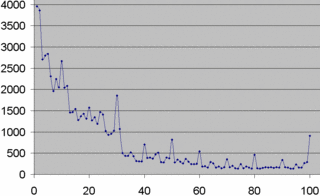 x-axis represents the number queried, y-axis represents matched documents in millions under Google's Sept 13, 2005 corpus
Thankfully, there existed no easily roused DoS-prevention logic and so my perl script was sportingly allowed to run unimpeded.
Observing the data, we see that lower magnitude numbers reign supreme as expected, followed by their products by 10 and to a lesser extent theirs by 5. Our odd decision to make seconds and minutes base-60 probably encouraged the high popularity of 30. Shopkeepers who price everything one or two cents shy of a whole buck are the likely reason for the spikes at 98 and 99. Curse their financial legerdemain! I snuck in 100 despite it being triple-digit to show my solidarity with our love of base-10. If you must know, I originally had 0 as well but it made the scatterplot rather messy with its frequency being between those of 12 and 13. Notably apparent from the chart, there is nothing strikingly special about 42 or 47.
So there you have it, confirmation that the '80s really were boring, and incontrovertible proof that neither 42 nor 47 are in any way more spectacular than other numbers in the hearts and minds of sane, normal people. The atypically higher frequencies of 44 and 64 do on the other hand raise new questions...
After all this faux statistical analysis of 'cult-figures', it is perhaps prudent to reflect on the sagacious words of Homer J. Simpson.
His eminence's eloquent words denouncing statistically based reasoning. Amen, Mr. Simpson, amen.
In a bid to cure myself of susceptibility to mind control by those who'd reap the awesome power of these two numbers, and under the premise that few enough netizens are infected with these memes to constitute any significant alteration to these numbers' use — a premise I'm sure we can all agree upon given the growing ubiquity of non-geeks online — I thought I'd query Google, our very own 'Deep Thought', on what it thinks about single and double-digit numbers. Here are the results:
 x-axis represents the number queried, y-axis represents matched documents in millions under Google's Sept 13, 2005 corpus
Thankfully, there existed no easily roused DoS-prevention logic and so my perl script was sportingly allowed to run unimpeded.
Observing the data, we see that lower magnitude numbers reign supreme as expected, followed by their products by 10 and to a lesser extent theirs by 5. Our odd decision to make seconds and minutes base-60 probably encouraged the high popularity of 30. Shopkeepers who price everything one or two cents shy of a whole buck are the likely reason for the spikes at 98 and 99. Curse their financial legerdemain! I snuck in 100 despite it being triple-digit to show my solidarity with our love of base-10. If you must know, I originally had 0 as well but it made the scatterplot rather messy with its frequency being between those of 12 and 13. Notably apparent from the chart, there is nothing strikingly special about 42 or 47.
So there you have it, confirmation that the '80s really were boring, and incontrovertible proof that neither 42 nor 47 are in any way more spectacular than other numbers in the hearts and minds of sane, normal people. The atypically higher frequencies of 44 and 64 do on the other hand raise new questions...
After all this faux statistical analysis of 'cult-figures', it is perhaps prudent to reflect on the sagacious words of Homer J. Simpson.
1F09, 1/6/94 Homer the Vigilante
Kent: Mr. Simpson, how do you respond to the charges that petty vandalism such as graffiti is down eighty percent, while heavy sack-beatings are up a shocking 900%?
Homer: Aw, people can come up with statistics to prove anything, Kent. Forty percent of all people know that.
His eminence's eloquent words denouncing statistically based reasoning. Amen, Mr. Simpson, amen.
Tuesday, September 06, 2005
Attending a Desi Wedding in Cincinnati
Labor day weekend went by rather well! Whenever any sort of long weekend creeps up, my family begins by expressing a warm, embracing intention to vacation somewhere. This wishful thinking must be quite taxing because my parents seem to move directly onto appeased inaction, bypassing the entire stage where one normally would book a flight and a room. This brilliant tactic of omission allows a vacation "planned" a month in advance to disintegrate into ether, leaving my family panic stricken the week of our supposed excursion and ultimately resigned to satiate our wanderlust another time. Despite this, somehow, maybe when the stars align, we get our act together and manage to go somewhere. This labor day weekend owes itself to one such cosmic arrangement. And, oh, what a weekend it was!

The Groom as White Knight
The Bride and Groom
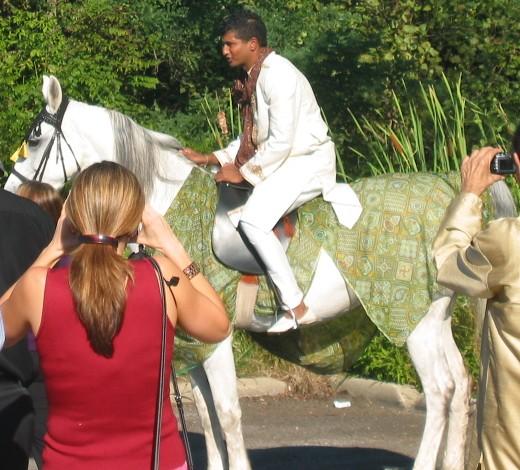
Weddings are always special occasions, but this desi wedding meant a three-day gala affair with the groom riding on a white stallion! In the picture to the right you can see the groom mounted on the steed. Truth be known, an equestrian trainer pulled it along, and it was for less than an hour, but still... a horse!
Since the groom is Tamilian and the bride is Gujarati, the wedding combined traditional North Indian style with traditional South Indian style. Hey, if it means more variety in sweets for the guests, I say combine away!
Unfortunately, owing to the paucity of Indian weddings I've attended, I'm not exactly sure which all aspects were Southern inspired and which all were Northern inspired. The ancillary use of the horse, by the way, is primarily a North Indian phenomenon, and may even be confined further to Gujarat. I know, I know, I'm a bad coconut with only a vague understanding of these things. I'm trying, right?


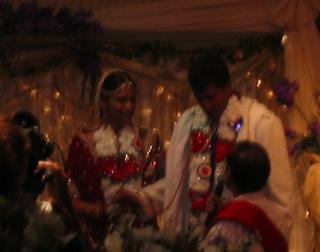
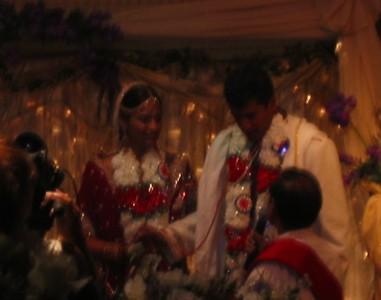
The photo to the left shows the general theme and the apparel worn. The guys in red on the rightside are mostly the groom's friends from Chicago. The girls in red saris are sisters of the bride. People are pumping their arms into the air as they dance to Hindi music in a procession behind which faint and gentle clacks of horseshoes emanate.
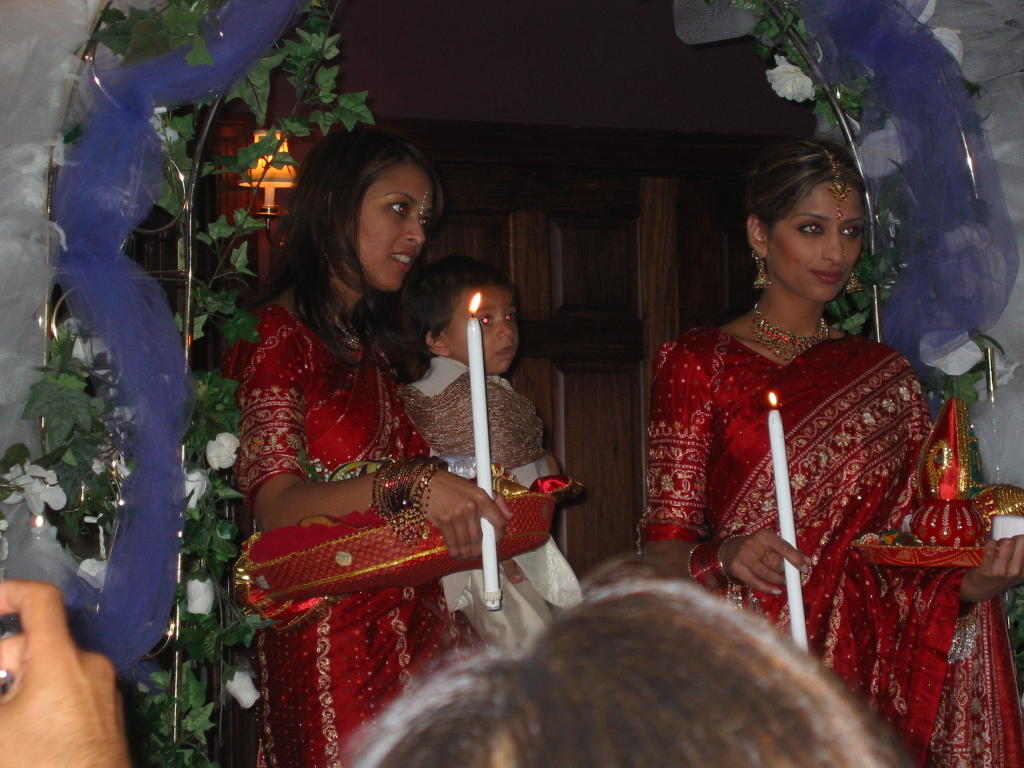
Arches and candles are among the more artistic items one can capture with a still; yet, some guy has the impeccable timing to get up and ruin my shot. Oh well.
I probably should cast a little of Cincinnati's limelight over on Kentucky since the latter is where most of the events actually took place. Barefaced about being a geography dunce, I never realized Cincinnati practically grows out from Ohio and into Kentucky! Makes me wonder, though, if Mr. Ed from the first photograph was ever in the Kentucky derby.
The Groom as White Knight
The Bride and Groom
Weddings are always special occasions, but this desi wedding meant a three-day gala affair with the groom riding on a white stallion! In the picture to the right you can see the groom mounted on the steed. Truth be known, an equestrian trainer pulled it along, and it was for less than an hour, but still... a horse!
Since the groom is Tamilian and the bride is Gujarati, the wedding combined traditional North Indian style with traditional South Indian style. Hey, if it means more variety in sweets for the guests, I say combine away!
Unfortunately, owing to the paucity of Indian weddings I've attended, I'm not exactly sure which all aspects were Southern inspired and which all were Northern inspired. The ancillary use of the horse, by the way, is primarily a North Indian phenomenon, and may even be confined further to Gujarat. I know, I know, I'm a bad coconut with only a vague understanding of these things. I'm trying, right?

The photo to the left shows the general theme and the apparel worn. The guys in red on the rightside are mostly the groom's friends from Chicago. The girls in red saris are sisters of the bride. People are pumping their arms into the air as they dance to Hindi music in a procession behind which faint and gentle clacks of horseshoes emanate.
Arches and candles are among the more artistic items one can capture with a still; yet, some guy has the impeccable timing to get up and ruin my shot. Oh well.
I probably should cast a little of Cincinnati's limelight over on Kentucky since the latter is where most of the events actually took place. Barefaced about being a geography dunce, I never realized Cincinnati practically grows out from Ohio and into Kentucky! Makes me wonder, though, if Mr. Ed from the first photograph was ever in the Kentucky derby.
Tuesday, August 30, 2005
Acting with a Gracious Aussie, Politics at the Pool Table
I won! Wait, I won?
It takes quite a lot of skill to throw a game convincingly. The fact I'm still uncertain over whether the game was actually thrown is testament to my opponent's crafty generosity, if he really did let me win. I suspected something was awry when I narrowed his lead over me while he kept encountering a rash of difficulties with getting the 8-ball into any pocket, until that cathartic moment when, after a few of my own fumbling moments with the 8-ball, I won. Wow. At that moment, as strongly as I sensed victory was being handed to me, a feeling of redemption engulfed any other worries or misgivings I had. For an instant, lingering questions on the legitimacy of the victory evaporated, as did the tension of being down 0-4 games, a tension I grew so accustomed to as to fail to recognize how taut and clenched-fisted it had been keeping me. While the tension seemed permanently subsided, those lingering questions were less willing to go, coalescing into an anvil and thudding atop my head with the pestering realization that I need to think of how to respond beyond showcasing motionless stupor and disbelief.
What's the protocol, I wondered; do I sneak in a teaser about how he let me win? Should I thank him for the gracious gesture? Perhaps he would be offended if I garishly threw noise on a donation he so discretely made. Then again, I did still have to struggle - he certainly wouldn't have fiddled with that 8-ball long enough to embarrass himself. In fact, in addition to the onus of winning being on me, I had to endure the added pressure of potentially losing to someone playing on a five shot handicap. Yes.. yes.. the victory was well earned. Besides, I continued to reason, it would be sacrilegious of me to call his act an act when he expended considerable effort to make his loss credible. I decided to accept his donation; I played the intended part and offered a courteous "good game" with an appreciative smile and a nod. I instantly second-guessed myself, wondering if silently accepting someone's largesse would be considered tawdry, but, thankfully, the comforting return of relief from my opponent's starkly more relaxed look allayed any fear of misstep. He bought the act, or so I believe.
It takes quite a lot of skill to throw a game convincingly. The fact I'm still uncertain over whether the game was actually thrown is testament to my opponent's crafty generosity, if he really did let me win. I suspected something was awry when I narrowed his lead over me while he kept encountering a rash of difficulties with getting the 8-ball into any pocket, until that cathartic moment when, after a few of my own fumbling moments with the 8-ball, I won. Wow. At that moment, as strongly as I sensed victory was being handed to me, a feeling of redemption engulfed any other worries or misgivings I had. For an instant, lingering questions on the legitimacy of the victory evaporated, as did the tension of being down 0-4 games, a tension I grew so accustomed to as to fail to recognize how taut and clenched-fisted it had been keeping me. While the tension seemed permanently subsided, those lingering questions were less willing to go, coalescing into an anvil and thudding atop my head with the pestering realization that I need to think of how to respond beyond showcasing motionless stupor and disbelief.
What's the protocol, I wondered; do I sneak in a teaser about how he let me win? Should I thank him for the gracious gesture? Perhaps he would be offended if I garishly threw noise on a donation he so discretely made. Then again, I did still have to struggle - he certainly wouldn't have fiddled with that 8-ball long enough to embarrass himself. In fact, in addition to the onus of winning being on me, I had to endure the added pressure of potentially losing to someone playing on a five shot handicap. Yes.. yes.. the victory was well earned. Besides, I continued to reason, it would be sacrilegious of me to call his act an act when he expended considerable effort to make his loss credible. I decided to accept his donation; I played the intended part and offered a courteous "good game" with an appreciative smile and a nod. I instantly second-guessed myself, wondering if silently accepting someone's largesse would be considered tawdry, but, thankfully, the comforting return of relief from my opponent's starkly more relaxed look allayed any fear of misstep. He bought the act, or so I believe.
Tuesday, August 09, 2005
Robert Blackwill, Dictionaries, and p[a-z]*pot(ate|ent)
Despite a gleaming mention in the subject, Robert Blackwill has very little to do with this particular journal entry. In fact, he is merely part of the ambient noise surrounding a slippery word that tantalizingly evaded me. It's quite odd how, when focusing so intently on recollecting one thing, loosely related items emerge into thought and, though unsolicited, they emerge with unbridled clarity and brilliance.
I began explaining to a friend how I hate synonyms and prefer words which carry a larger concept - a purposeful word useful in reducing the amount of time to convey an idea. At that moment, I caught the shadow of a word which would be of prime example; unfortunately, anything more than the shadow eluded me. Lilipote? No, no. What was it? I struggled to think. I knew its definition is the use of a euphemism or understatement for emphasis. I started rattling off to my friend whatever I could think to see if the word would come to me. If two people are berated by an extremely mean officer, one can later use hyperbole to tell the other "that's the worst officer ever in history!" One can also use sarcasm to tell the other "he sure is a nice guy." One can also use a .. er .. lilipote to tell the other "he's not an extremely nice guy." Tragically, I was in the car without internet access. I asked my friend over the phone to google "lilipote" and although I was expecting no results, it was disheartening to be confronted with that reality. It did make for a decent segue into Lilliputs and from there the conversion meandered to other things of interest, such as the movie about a 40yr old male virgin, and away from this mess of grappling with quarter-life senility.
To ensure no one's spirits have risen in thinking this blog will delve into the interesting parts of that conversation, I should make clear that interesting movie-related discussion will never be in any blog I write. Interesting stories can easily be told to people, real-time; it's the uninteresting things which require the occasional straggler who resorts to reading blogs, having tired of hours of solitaire.exe and an additional hour of repeatedly dragging rectangles on her desktop to see icons highlight. Right, now that we've squared that away.. Once I arrived home and the conversation ended, I managed to remember 'litotes' was the word I likely was looking for, and a quick validation on the web vindicated my belated answer. Naturally, just before feeling the burden lifted, I remembered once knowing a word used in a many years old NY Times passage about then ambassador Robert Blackwill being autocratic and sinking his staff into depression by incessantly denigrating them. I knew the word meant something along the lines of being given authority or power by appointment; other than that, I only knew it began with something like "pen" and ended with something like "potate" or "potent" which is sadly insufficient to query a web dictionary, or a printed one for that matter.
Cursed word-based queries, grep would solve this in seconds, I muttered. Wait, yes, grep will solve this in seconds! After some longer than anticipated tar.gz hunting, I seemed to find numerous providers of the 1913 Webster's unabridged English dictionary, which has fortunately been released into public domain. With some tr, sed, and sort -u, I had a nice greppable txt file revealing 'plenipotentiary', carrying as a noun the meaning "a diplomatic agent, such as an ambassador, fully authorized to represent his or her government" and as an adjective "invested with or conferring full powers." Aha, excellent. If only there had been a web service to do this generally! Are you listening, Google? I seriously need a mind-augmenting persistent cache to prevent memory loss. As an aside, as if this whole posting wasn't a giant one, a month and a half ago I managed to utter "Al Grove" in place of "Carl Rove", seamlessly morphing him with a certain former vice president and presidential candidate I'll leave unnamed. Needless to say, that gaffe instantly clinched an unofficial debate victory for my heckling opponent.
I began explaining to a friend how I hate synonyms and prefer words which carry a larger concept - a purposeful word useful in reducing the amount of time to convey an idea. At that moment, I caught the shadow of a word which would be of prime example; unfortunately, anything more than the shadow eluded me. Lilipote? No, no. What was it? I struggled to think. I knew its definition is the use of a euphemism or understatement for emphasis. I started rattling off to my friend whatever I could think to see if the word would come to me. If two people are berated by an extremely mean officer, one can later use hyperbole to tell the other "that's the worst officer ever in history!" One can also use sarcasm to tell the other "he sure is a nice guy." One can also use a .. er .. lilipote to tell the other "he's not an extremely nice guy." Tragically, I was in the car without internet access. I asked my friend over the phone to google "lilipote" and although I was expecting no results, it was disheartening to be confronted with that reality. It did make for a decent segue into Lilliputs and from there the conversion meandered to other things of interest, such as the movie about a 40yr old male virgin, and away from this mess of grappling with quarter-life senility.
To ensure no one's spirits have risen in thinking this blog will delve into the interesting parts of that conversation, I should make clear that interesting movie-related discussion will never be in any blog I write. Interesting stories can easily be told to people, real-time; it's the uninteresting things which require the occasional straggler who resorts to reading blogs, having tired of hours of solitaire.exe and an additional hour of repeatedly dragging rectangles on her desktop to see icons highlight. Right, now that we've squared that away.. Once I arrived home and the conversation ended, I managed to remember 'litotes' was the word I likely was looking for, and a quick validation on the web vindicated my belated answer. Naturally, just before feeling the burden lifted, I remembered once knowing a word used in a many years old NY Times passage about then ambassador Robert Blackwill being autocratic and sinking his staff into depression by incessantly denigrating them. I knew the word meant something along the lines of being given authority or power by appointment; other than that, I only knew it began with something like "pen" and ended with something like "potate" or "potent" which is sadly insufficient to query a web dictionary, or a printed one for that matter.
Cursed word-based queries, grep would solve this in seconds, I muttered. Wait, yes, grep will solve this in seconds! After some longer than anticipated tar.gz hunting, I seemed to find numerous providers of the 1913 Webster's unabridged English dictionary, which has fortunately been released into public domain. With some tr, sed, and sort -u, I had a nice greppable txt file revealing 'plenipotentiary', carrying as a noun the meaning "a diplomatic agent, such as an ambassador, fully authorized to represent his or her government" and as an adjective "invested with or conferring full powers." Aha, excellent. If only there had been a web service to do this generally! Are you listening, Google? I seriously need a mind-augmenting persistent cache to prevent memory loss. As an aside, as if this whole posting wasn't a giant one, a month and a half ago I managed to utter "Al Grove" in place of "Carl Rove", seamlessly morphing him with a certain former vice president and presidential candidate I'll leave unnamed. Needless to say, that gaffe instantly clinched an unofficial debate victory for my heckling opponent.
Tuesday, May 31, 2005
Cursory Game Review of "Rome: Total War"
Developed by The Creative Assembly and published in 2004 by Activision, the latest in the Total War series, Rome: Total War, far exceeds any expectations set by Warcraft in warfare while borrowing from the allure of Civilization (Civ) and Master of Orion (MoO). Like Civ, the macroscopic management of the empire (involving the queuing of building structures, the queuing of training troops, and the movement of troops across the available map) is turn-based; however, the time (number of turns) to produce a building or unit is, like Warcraft and unlike Civ, a fixed number of turns dictated by the item being constructed or trained rather than the manufacturing capabilities of the city. Like MoO, battles are fought optionally as mini-games. Unlike MoO, these mini-games are real-time and follow in the genre of Command and Conquer (C&C) and Warcraft but replace the old C&C and Warcraft era maps with true 3D terrain, camera perspective, and high-resolution military units comprised of twenty to fifty individually animated characters per unit. Also unlike MoO, when declining to manually play a mini-game, the player merely is given (and rightfully so) the statistical end-result instead of peering into the 5-10min long battle animation which would otherwise ensue. In brief, this game borrows heavily from, and exhibits itself as, a medley of classic strategy war games, yet does so as would a good recipe harmoniously blend common palatable flavors while adding a few hitherto uncommon ones.
The storyline while lackluster is implemented in a very novel manner. The ahistorical premise of the game is that the Senatus Populusque Romanus (SPQR) wishes to expand Rome vicariously through three powerful Roman houses, the Julii, Scipii, and Brutii. The player's avatar is the faction leader of one of these three houses - the particular house being chosen when creating a new game. The Senate will give time-bound missions incentivized with modest rewards to help steer the player’s faction. Cities cannot be formed or destroyed as would have been able in Civ; instead, each faction simply advances by conquering existing cities and choosing to either occupy, enslave (dispersing 25% of the population to other cities), or exterminate (lowering the population by 75%). Initially, many of the available cities are rebel-owned. These rebel cities have no allegiance and cannot form diplomatic channels and are thus fodder for adjacent civilizations. The player’s faction is initially allied with the SPQR and the other two Roman factions. The Julii house would typically expand northward and northwestward into Gallic territory. The Brutii house would typically expand southeastward and eastward into Greek and Macedonian territory. The Scipii house would typically expand southward and southwestward into Carthaginian territory. Later in the game, Rome expands into Germanic, Dacian, Seleucid, Thracian, Spanish, Scythian, Egyptian, Briton and other territories. The objective of the game is to own the Senate while possessing 50 provinces. Like Civ, the best way to achieve the objective is to build structures improving the economy, city defenses, and sanitary conditions. Like Warcraft, military units have prerequisite military structures, one upgrade path for various infantry units, another for various cavalry units, another for various missile units, and yet another for various naval units. A blacksmith or armourer in the city is the only exception, helping improve the quality of weapons for all military units.
Curiously unlike most other strategy games, family members of the faction's patriarchy are important. All the characters gain virtues and vices over time, form entourages conferring insight, marry and propagate, and eventually die as in real life. Some characters may even be elected into the senate and rise through the various bureaucratic ranks. While moderately complex for a strategy game, much of the complexity is mitigated by being read-only. The only control on the family the player has is in selecting the heir, choosing to betroth a female family member to a requesting suitor, and occasionally choosing to adopt into the family a commander who has shown his mettle in combat. Male family members of age (sixteen or older) appear as a General at the capital, carrying modifiers set by his virtues, vices, and the traits of his retinue. These modifiers can affect anything from the morale of troops at battle to the cost of erecting buildings in the city to the chances of rising in the bureaucracy of the senate to the likelihood of having many children. Like any other unit, a General - and, importantly, his modifiers - can be moved across the map from city to city or battle to battle. Less importantly, in real-time battle mini-games, a General often appears as a cavalry unit of 10-20 horsemen - which can have some minimal, direct use. Gameplay-wise, the 10-20 horsemen simply indicate the General's "health" since each horseman bimodally either survives combat or dies during it.
The quality of the mini-games' graphics is astounding, even when using a slightly older (circa 2002) graphics card requiring one to disable various aesthetic features. Unlike the motion-picture implementation in C&C and Warcraft utilizing a dozen key frames, Rome: Total War uses proper 3D animation, vector-based with perhaps five dozen inflection states involving the categorical concepts of marching, running, fleeing, scrimmaging and, for missle units, firing. The viewing camera is, seemingly, several meters above the ground, angled downward toward the battlefield. The height and downward angle of the camera are automanaged and read-only, but the player may polar rotate and cartesian translate the terrestrial plane. Whenever the axis of height is important (viewing units on a slope or viewing from a slope), the camera's automanager will correct the height and downward angle of the camera to provide suitable sight.
Throughout this review, I have been doing a grave disservice by referring to the real-time battles as mini-games; in actuality, these real-time battles can be the sole focus of the game and the creators cleverly catalogue historical battles for instant play, dismissing the need to ever plod along a tiring and lengthy Civ-style campaign. True to its mission of being realistic while fun to play, battles occur on a giant arena which may take 10min to walk across with infantry. Fortunately, your opponent tends to be positioned a minute away. Woodlands and hills can shift the balance of power in battle, forcing one side to fight an uphill battle or render its siege weapons immobile due to absence of clear terrain. Town Watchers, Hastati, Principes and Triarii are, in ascending order of power, the infantry and heart of Roman might early in the game. The various cavalry and missile-based cavalry units are fast, useful to prey on outlying infantry or to pierce a hole in the opponent's rank. Velites, Archers, and the ancient world's engineering marvels such as ballistas and onagers are strategic units with limited but invaluable uses. There are also special units various civilizations possess. A dearth of elephants available to Rome, and consequent cultural abhorrence of elephants and denigration of the militarization thereof, makes this unit unavailable to a Roman army while available to a Carthaginian one. Similarly, pikeman and other units are for exclusive use by certain civilizations. Once the battle is underway, formations prove vital. Morale and effectiveness of one's units are heavily dependent on orderliness, easily disrupted by beasts such as wardogs and elephants or by swift, indefatigable cavalry. A pivotal unit may quickly flee long before it could ever be vanquished if the men are disheartened by pervading chaos. Most units, unfortunately, are limited to the dull blocks legionnaires classically form; however, cavalry can form rhomboid and wedge formations, cavalry auxilla - missile-equipped cavalry - can also form a Cantabrian circle around their prey, and legionnaires during sieges can form a testudo, the oft-romanticized 'invincible' tortoise formation. Given the richness present elsewhere in the game, the unvariedness of formations is a puzzling oversimplification. Perhaps this streamlining correctly portrays the genuine monotony of roman formations. Thankfully, spectacles such as incendiary pigs – oil drenched, violent pigs unleashed upon an enemy and later ignited by fire-arrows to wreak one-time devastation on the opponent – more than make up for the narrow range of formations.
The storyline while lackluster is implemented in a very novel manner. The ahistorical premise of the game is that the Senatus Populusque Romanus (SPQR) wishes to expand Rome vicariously through three powerful Roman houses, the Julii, Scipii, and Brutii. The player's avatar is the faction leader of one of these three houses - the particular house being chosen when creating a new game. The Senate will give time-bound missions incentivized with modest rewards to help steer the player’s faction. Cities cannot be formed or destroyed as would have been able in Civ; instead, each faction simply advances by conquering existing cities and choosing to either occupy, enslave (dispersing 25% of the population to other cities), or exterminate (lowering the population by 75%). Initially, many of the available cities are rebel-owned. These rebel cities have no allegiance and cannot form diplomatic channels and are thus fodder for adjacent civilizations. The player’s faction is initially allied with the SPQR and the other two Roman factions. The Julii house would typically expand northward and northwestward into Gallic territory. The Brutii house would typically expand southeastward and eastward into Greek and Macedonian territory. The Scipii house would typically expand southward and southwestward into Carthaginian territory. Later in the game, Rome expands into Germanic, Dacian, Seleucid, Thracian, Spanish, Scythian, Egyptian, Briton and other territories. The objective of the game is to own the Senate while possessing 50 provinces. Like Civ, the best way to achieve the objective is to build structures improving the economy, city defenses, and sanitary conditions. Like Warcraft, military units have prerequisite military structures, one upgrade path for various infantry units, another for various cavalry units, another for various missile units, and yet another for various naval units. A blacksmith or armourer in the city is the only exception, helping improve the quality of weapons for all military units.
Curiously unlike most other strategy games, family members of the faction's patriarchy are important. All the characters gain virtues and vices over time, form entourages conferring insight, marry and propagate, and eventually die as in real life. Some characters may even be elected into the senate and rise through the various bureaucratic ranks. While moderately complex for a strategy game, much of the complexity is mitigated by being read-only. The only control on the family the player has is in selecting the heir, choosing to betroth a female family member to a requesting suitor, and occasionally choosing to adopt into the family a commander who has shown his mettle in combat. Male family members of age (sixteen or older) appear as a General at the capital, carrying modifiers set by his virtues, vices, and the traits of his retinue. These modifiers can affect anything from the morale of troops at battle to the cost of erecting buildings in the city to the chances of rising in the bureaucracy of the senate to the likelihood of having many children. Like any other unit, a General - and, importantly, his modifiers - can be moved across the map from city to city or battle to battle. Less importantly, in real-time battle mini-games, a General often appears as a cavalry unit of 10-20 horsemen - which can have some minimal, direct use. Gameplay-wise, the 10-20 horsemen simply indicate the General's "health" since each horseman bimodally either survives combat or dies during it.
The quality of the mini-games' graphics is astounding, even when using a slightly older (circa 2002) graphics card requiring one to disable various aesthetic features. Unlike the motion-picture implementation in C&C and Warcraft utilizing a dozen key frames, Rome: Total War uses proper 3D animation, vector-based with perhaps five dozen inflection states involving the categorical concepts of marching, running, fleeing, scrimmaging and, for missle units, firing. The viewing camera is, seemingly, several meters above the ground, angled downward toward the battlefield. The height and downward angle of the camera are automanaged and read-only, but the player may polar rotate and cartesian translate the terrestrial plane. Whenever the axis of height is important (viewing units on a slope or viewing from a slope), the camera's automanager will correct the height and downward angle of the camera to provide suitable sight.
Throughout this review, I have been doing a grave disservice by referring to the real-time battles as mini-games; in actuality, these real-time battles can be the sole focus of the game and the creators cleverly catalogue historical battles for instant play, dismissing the need to ever plod along a tiring and lengthy Civ-style campaign. True to its mission of being realistic while fun to play, battles occur on a giant arena which may take 10min to walk across with infantry. Fortunately, your opponent tends to be positioned a minute away. Woodlands and hills can shift the balance of power in battle, forcing one side to fight an uphill battle or render its siege weapons immobile due to absence of clear terrain. Town Watchers, Hastati, Principes and Triarii are, in ascending order of power, the infantry and heart of Roman might early in the game. The various cavalry and missile-based cavalry units are fast, useful to prey on outlying infantry or to pierce a hole in the opponent's rank. Velites, Archers, and the ancient world's engineering marvels such as ballistas and onagers are strategic units with limited but invaluable uses. There are also special units various civilizations possess. A dearth of elephants available to Rome, and consequent cultural abhorrence of elephants and denigration of the militarization thereof, makes this unit unavailable to a Roman army while available to a Carthaginian one. Similarly, pikeman and other units are for exclusive use by certain civilizations. Once the battle is underway, formations prove vital. Morale and effectiveness of one's units are heavily dependent on orderliness, easily disrupted by beasts such as wardogs and elephants or by swift, indefatigable cavalry. A pivotal unit may quickly flee long before it could ever be vanquished if the men are disheartened by pervading chaos. Most units, unfortunately, are limited to the dull blocks legionnaires classically form; however, cavalry can form rhomboid and wedge formations, cavalry auxilla - missile-equipped cavalry - can also form a Cantabrian circle around their prey, and legionnaires during sieges can form a testudo, the oft-romanticized 'invincible' tortoise formation. Given the richness present elsewhere in the game, the unvariedness of formations is a puzzling oversimplification. Perhaps this streamlining correctly portrays the genuine monotony of roman formations. Thankfully, spectacles such as incendiary pigs – oil drenched, violent pigs unleashed upon an enemy and later ignited by fire-arrows to wreak one-time devastation on the opponent – more than make up for the narrow range of formations.
Graphics: 8 /10
Gameplay: 6½/10
Novelty:  8 /10
Subscribe to:
Posts (Atom)