Hello Paul,
I hope you're not being inundated with slashdot readers writing their feedback. I'm certainly not lessening the effect by writing, but I feel I should write since I enjoyed reading your graduation speech and am as dismayed as you that it couldn't be delivered. I'm not in highschool anymore, but mentoring highschool students in my free time I know your advices and anecdotes to unveil reality are good ones. I've even forwarded your webpage to my younger cousins who themselves are in college but still very curious about life, the division between childhood and adulthood, and the "point of life" - to stay upwind as you put it.
Apart from my compliments, I also have a suggestion, which I'll get to after a short anecdote of my own. I was very mathematically inclined as a kid and delved into software more than most I knew. All along, I had only one friend whom I could learn from and he equally learned from me. Even my father who was a software developer was uninterested in the murkier topics of computer science theory, such as lambda calculus, frequency analysis, and feistel networks, as the practicing world cared more about programming libraries. Needless to say, it was a difficult journey to learn and a lonely one at that. I knew college would be better, but that's eons away when you're in eighth grade. I stumbled upon linux, open source, and a community working on things without monetary purpose nearing the end of my tenth grade. My first email communique outside of my highschool was to Andrew Tridgell, then the sole samba developer. I had my vague notions of tcp and udp and OS datagram frames but in one email response he clarified questions I would've spent the next year analyzing. Instantly, solitary learning where I learn from my mistakes like an ape became human learning where I stood on civilization learning the past mistakes of all. It was incredible, and I wish I hadn't had to have stumbled on that revelation.
I'm not saying open source is the answer to everyone's grade school intellectual doldrums, even if it was my answer; I'm saying that a useful community will inevitably exist outside college, and highschool students impatient for that college life can tap into it earlier. The key element is people. Most students, including both the academic ones trying to learn and the non-academic ones trying to be popular, will benefit from the idea that there are more people to know and learn from than those in their own school. I know of far too many students who never communicate in email or chat beyond their school classmates, and parents unfortunately find that comforting. The concept I couldn't grasp was how many 6 billion people are and yet how only a few dozen people would be interested in samba in 1995. As a ratio, it's astounding. However, these non-popular -- distinctly separate from the unpopular -- projects are bastions of clever lonely people, the perfect type for a student with little to offer besides attention and a lot to gain such as knowledge.
Ergo, my suggestion. I believe it would be highly useful to impress upon students how they should look beyond their region - that while their home town may be the only place in the world to know certain inside jokes and terms, there are things far grander in the world and fractious enough as to make the individual teams small, closeknit, and meaningful. While being trendy and knowing the latest, local, and popular things can make one feel good about oneself, the eclectic, esoteric, and historical things are longer lasting benefits which compound with themselves in value over time. To be eclectic, however, one cannot be content with what is provided. I was very distrusting of supposed quality, and knew the world contained a spectrum of quality far greater than I could contemplate. Far too many people cling to the first anchorman, reporter, or developer they meet if they're interested in that subject. I suggest exploring and discerning whom to emulate.
Being mindful of history is necessary in order to be eclectic. Old news tends to be overlooked, or be seen as unprofitable, making it somewhat immune from the noise of limelight seekers' premature ideas and from marketing propaganda. There's money in making software, not in writing a taxonomy of comparisons between, or meticulously documenting the concepts wielded by, different software. There are even taxonomies on taxonomies, each level becoming less popular and less profitable and taking longer to complete, thereby missing the slim window of public interest. However, by sitting in 1995 and reading tcp/ip lessons in 1994 about lessons from 1991 etc., dating back to the release of the cornell worm in 1970, one could learn a lot more than if one had only read some arbitrary book circa 1980 focusing purely on unproven and trendy '80s paradigms. I've given the following advice to many: we should look at the thirty year topics that are still alive today, even if barely, and trace the discussion back to their origins. By learning from the collective discussion, any contemporary incident can be seen through the lens of a learned person, yielding an amalgam of concepts surviving a darwinian massacre of preceding years' ideas. Once the lens has been shaped, it serves as a crude tool to craft finer tools. Apply that lens on another, more recent, incident, and repeat the process until you're looking at present day situations with an extremely well-pruned, eclectic corpus of knowledge with which to interpret anything you choose. This strategy works tremendously well at solving the problem of "noise" -- too much nonsense posing as quality work; and, interestingly, this same approach is taken by bayesian spam filtering.
Sorry for writing as much as I have - it was originally meant to be two or three short paragraphs. Pardon me for any typographical errors.
Cheers,
(My name)
Thursday, February 05, 2009
Re: high school graduation speech

Tuesday, April 22, 2008
Fun with Number Theory: Guessing Your Age
- Take the last digit of your age, multiply it by 2, then for every decade you've lived add 1 to it. Color this result Blue in your mind
- Think of your favorite digit, any digit at all, multiply it by 11.
- Add the last digit of your age to the previous result.
- For every decade you've lived subtract 1 from the previous result. This is your Red number.
© 2008 by Thoreaulylazy. All Rights Reserved.
Spoilers:
Monday, March 10, 2008
astrology in the modern world
I think you meant to say astrology is 50% wrong, because if it were 100% wrong, it would have perfect anti-correlation (akin to scoring a perfect zero on a T/F test, and is just as difficult as scoring a perfect 100). If astrology is 50% wrong, it therefore is 50% right, and depending on the brain chemistry of the person, happy memories may get weighted more than unhappy memories, and therefore the weighted average of astrology working can be significantly higher than 50% - assuming a person who adheres to astrology derives happiness from when it is correct. In fact, for such a person whose happy memories are weighted more than unhappy memories, any catalyst for increased variance will lead to a happier life, including a coin-toss on whether to drive or walk to work. If astrology is a method to higher variance in the day to day experiences of its adherents, then so be it, it results in a happier life among those humans who benefit from high variance. Conversely, for those whose brain chemistry weights unhappy memories more than happy memories, lowered variance in day to day experience is the best method for maximizing happiness. The world needs both people, those who enjoy variance and are willing to eat a mysterious berry, be it a sweet, tasty berry or a bitter, sour berry, and those who hate variance and will only eat the safe, known berry. The risk-takers help society learn about new, tasty berries, and the risk-averse help society continue the species in case the berries were poisonous after all. Astrology is merely a shrub blooming random berries, half of which are sweet (+1 correlation), half of which are bitter (-1 correlation).
Sunday, March 02, 2008
Re: Oscar's
As an octogenarian, I remember vividly when I was at the voting poll having to decide whether to vote for Gaydolph Titler or not. I recalled the numerous positions Titler had held and while I agreed on his stance on nearly every issue, when it came down to pulling the lever and casting my vote, I just couldn't in good faith vote for Titler. It was a shallow decision which I have regretted to this day. Now in my ripe old age, I worry far less what others may think of me, and this time around I shall cast my vote for Barrack Hussein Obama with my chin held high, or at least as high as my Osteoporosis permits me.
Wednesday, May 30, 2007


Saturday, May 26, 2007
The Culture Divide
I agree with you that there's a growing culture of living under a rock, more so since the end of the Cold War and the discontinuation of civics classes.
I think part of the problem is cultural – it's "cute" to be dumb, but "loserish" to be unathletic. A good deal of my classmates in university were foreign and I was amazed how, in their societies, the school celebrities were the 4.0 GPA guys going to math olympiads and the dudes playing sports were simply dismissed as loserish. Part of it comes from the fact that in most societies, but not ours, all exam scores are published on "The Wall". The Wall is a powerful tool in controlling social hierarchy. Anyone listed at the top becomes Alpha, by definition. Somehow, in our society, we stopped publishing exam scores, fearing that studies were becoming too competitive instead of collaborative. Yet, sports scores continued to be published, as were individual highschoolers' sports statistics. Therein undergirds our "jock culture". I truly believe that cultural differences are the consequence of social engineering and not historic reasons; the culture of a country can be changed on a dime, through informed govt. policies in social engineering or an uninformed govt. random walk.
I think another part of the problem is socio-economical. When the U.S. was poorer, certain professions were more valued. That is, the higher paying professions of doctors, lawyers, engineers, scientists, and bankers were seen as intrinsically more valuable than the lower paying professions of cashiers, hairdressers, and performance artists. This stereotype was reinforced at all levels, from politics to media to family values. Quite a few families in the '70s would sit down with their three to four kids and have "the talk" about which one of them the family can afford to send to college. To impressionable youngsters, this sort of separation of the wheat from the chaff can have a profound impact, perhaps exaggeratedly so, on the value of education. In many countries, this "talk" continues; many families still can only send one child to college, and it's important enough that it offsets the ostensible fairness of sending none of the kids to college.
More on socio-economics: I think the rise of nuclear families has divided our country along ideological lines. We nowadays choose our inner circle, presumably with toady fawners reinforcing our own world views, whereas with family, "you get what you get" – and this means dealing with, listening to, and respecting, a sundry of siblings, cousins, uncles, et al. who probably can never agree on anything other than that family must stick together through thick and thin. The level of compromise and empathy a few decades ago relative to today is phenomenal. With financial independence, an individual in 2007 has gained a lot of freedoms, but has lost, I believe, many of the qualities of interdependency that are necessary to broaden our horizons and to form a cohesive society. Not only that, but when failure is impossible or near impossible, as is true with our advanced society and fondness for safety nets, the Darwinian evaluation of people's choices disappears; all choices pass Darwin's test, and the new arbiter on which choices are "good" or "bad" no longer becomes survival, it becomes the echelon of pundits, priests, and other demagogues using the most specious of justifications.
There's a lot to be said about the power of heterogeneous families in removing barriers between cultures. Although too heavy handed by today's standards, Alexander of Macedon was a shrewd social engineer when ordering his generals to marry Asiatic wives to form Macedon-Asiatic offspring who would bridge the cultural divide. Ataturk ordered his subjects in Turkey to shave their beards and adopt European styles to stem the growing rift between Islam and Europe. There was a brief period when NASA and space research captured the awe and imagination of the nation, so perhaps there is hope for a cohesive future.
Tuesday, October 03, 2006
a dark descent
To fully grasp this difference, one needs to examine why, and how, nightmares are highly prevalent among dreamers. The capacity to conceive and envision often seems to dominate wishes to steer such untethered freethought toward constructive endeavors. More tragically, those with seemingly unbounded motivation and drive are motivated and driven by the same fuel on which the monster of insanity feeds, the fuel of self-programming, of mental constructs, of illusions.
Many credit adrenaline and various chemicals and hormones coursing through our veins as the fuel which drives us. While such biological assistants no doubt play a role, their effects are temporary, and their potency limited. In contrast, the truly powerful fuel is one that irreversibly reshapes our very perception of reality. Such discrete alterations to the psyche are rare, but many people know of them, and call them epiphanies. The brilliant are often blessed, and cursed, with far more epiphanies, and at such rapidity as to knock the psyche about until it loses the concept of stability.
This state of uncentered flux is not ominous; it is often transient, a time when men and women rediscover their being and contemplate on a redefinition of themselves. While the majority of people may redefine themselves once, twice, or thrice, in their lifetime, a few seem to harness the power of a mind that has lost a stable center on which to crystallize new thoughts predictably. A mind not allowed to solidify will remain in the unstructured, malleable state; this is the state in which young children live, in which they will believe what is told, in which they are programmable.
Of course, an adult mind cannot remain completely unstructured; the harsh realities of life would devour someone who exhibited neotenies like naïveté or ignorance. This results in a subconscious agreement of sorts, an agreement to keep the mind naïve and programmable only to itself, while keeping the mind highly wary and skeptical of others. This protection that seeks to guard the susceptible kernel of a malleable mind can exhibit itself as paranoia, sometimes at the healthy levels of a shrewd businessman, and other times at unhealthy levels of delusional proportions, both witnessed in the portrayal of Howard Hughes.
The ability to program oneself is a very peculiar one. It is an ability to alter the will of the subconscious with the forethought of the conscious. It is an ability that can lead to greatness. Many who know of the effort, diligence, and zeal required to attain success would envy anyone who possessed the ability to muster with merely a thought those same attributes while simultaneously banishing the psychological impediments of hedonism, lethargy, and timidity.
However, gaining such ultimate governance over oneself comes at a terrible price. While attuned thoughts of achievement can propel the pliant mind into attaining lavish goals, morbid thoughts can just as forcibly subjugate the pliant mind into vulgar obedience. The surreal quality of starkly teetering between unprecedented success and unprecedented dementedness only further stokes a fascination with crossing the boundaries at each end. At a certain point, the descent into dementia takes its toll on attaining further success, and instead of teetering between the two, one is plummeted into severe dementia. A normal mind would have dissenting opinions from within when an extreme action is contemplated, not so with someone suffering dementia. The seriously ill mind is under the control of a tyrannous dictator who brooks no tolerance for dissent. Even the most peculiar thoughts must be obediently carried out, not by an army of peasants, but by a single servant, the ill individual.
Fortunately, Howard Hughes' predicament isn't as bleak. While rumors and speculations of his mind's unraveling were rampant on account of his reclusiveness, Hughes managed to keep his wits intact long enough to become the nation's wealthiest man by 1966. Unavoidably, his world-famous eccentricities seemed to have caught up with him near the end years of his life, a time when his hedonism prevailed and he forwent the responsibility of caring for his own body. The claims that Hughes stored his own urine in bottles lie unsubstantiated, but history has substantiated claims that Hughes stopped brushing his teeth until they all fell out, that he let his hair and fingernails grow to grotesque lengths, and that he developed an insatiable desire for candy and brothels as his mind began its final, dark descent.
Tuesday, July 04, 2006
Fee! Fie! Foe! Fum! I smell the blood of an English data miner
 Fig 1. Google Ban™ screenshot through IE; 13,400 queries made in the span of approximately two hours
The datasets are partitioned by the host which I told Google to search within. I originally contrived an idea that I would somehow compare and contrast BBC, LiveJournal, Blogspot, and the general English corpus, but because of the nuissance posed by the wide fluctuation in the wordcount per webpage, I grew weary of trying to formulate insightful commentary that the data would support. The lazy bastard and quitter that I am, I shelved the idea of writing about the findings - or lack of findings - until this very epiphanal moment when writing about such a thing became the least boring in the long list of nauseatingly boring things I could be whiling away my time at.
 Fig 2. x-axis represents frequency rank, 1 being highest; y-axis represents frequency in units of webpages per billion in domain-specific corpora as measured by Google; dataset contains 3,500 randomly selected words from the 1913 Unabridged Merriam-Webster dictionary queried against each of 4 domains
The horizontal axis represents the ranking order of a word by descending frequency. That is, x=1 represents the most frequent word for each particular dataset, which may be "the" for one set, and may be "an" for another set; and x=383 represents the 383rd most frequent word for each particular dataset. The purpose of keeping things in descending order of frequency is to form a Zipf curve, which is visually smooth and tenders brownie points for allowing me to mention Zipf.
The vertical axis represents the search results returned by Google, multiplied by a coefficient that lets us pretend the most frequent word of any dataset has 1 billion search results. This multiplicative shifting was necessary to make the superimposition of datasets in a single plot less jarring. Unfortunately, such arithmetic jugglery creates jagged artefacts near the tail-end of the curves, as the words become less frequent. This unsightliness is the graphical pronouncement of integer search results multiplied by what was necessary to make the most frequent word show up as 1 billion. Under a log scale plot, there is little difference between y=1023 and y=1024, but quite a bit of difference between y=1 and y=2.
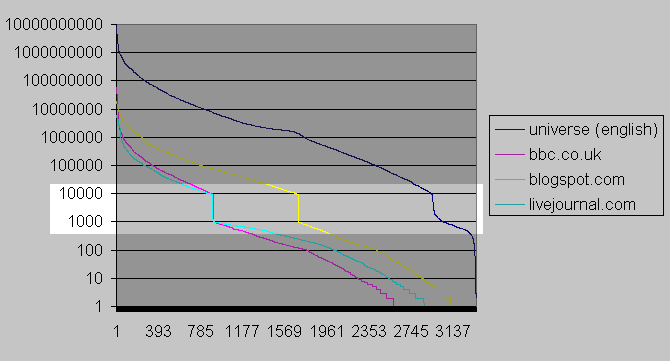 Fig 3. unscaled version of Figure 2
A notable, consistently reappearing anomaly is a discontinuity in the curves. This discontinuity, what I would dub The Google Chasm were it not for my vanity insisting on it being called The Thoreaulylazy Plunge, shows a steep dropoff in search results once the search results reduce to a navigable amount, which is 1,000 if you ever care to try to navigate to further and further pages in the google resultset.
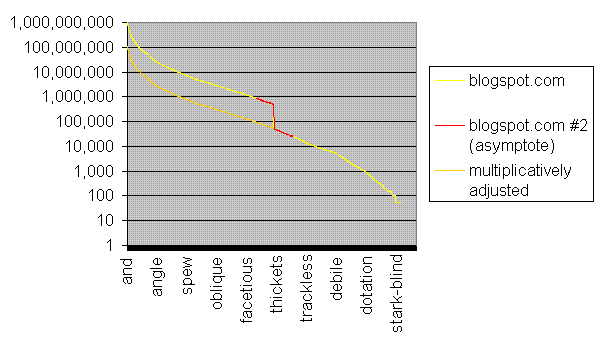 Fig 4. asymptotic region requeried the following week to check for reproducibility; plausibly inflated results multiplicatively deflated through division by 10 (approximately)
As a logical being, I would exhaust all avenues of explanation before spouting off fervently in an accusing tone. That said, I am baselessly laying the blame squarely on a Google conspiracy to inflate search results by a factor of ten once the results are no longer navigable and hence no longer easily verifiable. At some point, I should access the Google APIs under the free academic license and find out once and for all what this crevasse is all about. A mosey down into yahoo-land and a repeat of this data mining escapade may also prove fruitful as ammunition in my Google conspiracy claim. Ah, who am I kidding, I'm not persistent enough to furnish any evidence.
| universe | bbc.co.uk | blogspot.com | livejournal.com | |
| 1 | and | and | and | not |
| 2 | home | home | that | add |
| 3 | site | help | not | help |
| 4 | information | policy | home | and |
| 5 | that | skip | they | site |
| 6 | help | not | no | ask |
| 7 | policy | that | site | information |
| 8 | not | e | don | lost |
| 9 | e | responsible | see | yahoo |
| 10 | see | site | them | e |
| 11 | no | see | very | press |
| 12 | program | they | today | policy |
| 13 | press | edition | old | legal |
| 14 | they | related | big | that |
| 15 | related | northern | every | every |
| 16 | science | watch | place | kind |
| 17 | them | pictures | help | no |
| 18 | today | science | found | don |
| 19 | network | no | though | anyone |
| 20 | skip | them | photo | looking |
| -5 | direfrench | gristmill | galopade | meruit |
| -4 | vorspielgerman | congeries | exaltee | appurtenant |
| -3 | grstorgegr | enthymeme | conferva | inexpugnable |
| -2 | slipstickcoll | nosce | pegomancy | livraison |
| -1 | metrongr | federalize | solecize | chronogram |
Tuesday, June 20, 2006
a biennial anniversary of a stillbirth
The sense of suspense, the idea of even having suspense at all considering I read my own words, was exhilarating. Each new sentence drew me inside an exciting story world, so much so that had the story kept going, I would be dedicating an all-nighter just to reading it. Alas, it abruptly ended, mid-sentence no less! It was written during a time of transition, when I moved from California to Connecticut, and the date of my self-sent email, Friday, June 18th, 2004, was precisely the day I packed my computer for transport. Quite a shame, really. The story had such marvelous potential, and now it lies stillborn.
I feel a slight, incestual dirtiness loving a story I myself wrote, but considering I had absolutely no recollection nor reminding artifact of it for two entire years, I could not read it with the cruel criticism I otherwise would. Below is the full content of what was written:
“Ha ha,” Quincy ran in with that usual mischievous look to which Tom and Amanda could only greet with a gulp of trepidation. “You two absolutely have to come and see this!” he continued. “Well, put on your boots,” he chirped at the two, puzzled at their longer than usual stupor at being asked to go. The only thing more predictable than going on unknown expeditions with Quincy into the forest landscape surrounding their cottage was the certainty one would be beaten to a pulp refusing to go with him. He was the usual tall and husky kid, the type not to know his own strength when shoving his younger brother and sister into the dirt until they give in. It wasn’t as though Quincy was all bad – it’s just that Tom and Amanda have never seen him when he wasn’t. “Let’s get our boots Amanda,” Tom wearily slurred as he went to fetch them. “Hurry up!” echoed Quincy’s voice as the two emerged fully set for the outdoors.
* * *
“We’ve been out here for two hours; aren’t you going to tell us what we’re going to do this time?” Tom softly spoke in a resigning way. “Stop. We’re here!” Quincy’s voice bounced. “And,” Quincy turned to Tom with a sinister smile, “it’s not a question of what we are gonna’ do. It’s a question of what it will.” Tom could feel Amanda silently tightening her grip on his hands, to which he tries to reassuringly squeeze back. “Okay Quincy, let’s see it then.” Tom had a brave face on. “Oh, but first we have to have it see us,” Quincy added mysteriously, reaching into his jacket pocket to reveal a small hand mirror. After a bit of side-straggling, he positioned himself under strong rays of sunlight that managed to pierce through the treetops. He took the mirror and redirected focused light to what now appeared to look like a cave entrance, only it was so dark before no one saw the entrance apart from the adjacent rock. “Now we wait, it will come to us.” Almost as soon as he spoke, bats poured out of the cave like a flash flood, littering the entire sky with their dark fleshy wings and horrific shrieks. “Wait, just watch. Ah, yes, I can feel it rumbling in the air.” Oddly, Quincy didn’t seem interested in the bats; he had his eyes intent on a different place of the sky. “We’re not here to see those bats?” Tom questioned. “Shut up; of course we’re not here to see shitty bats. They’re food for it.” Amanda let out a muffled gasp, trying not to outright scream, her face now buried in Tom’s sweater with only one of her eyes peering out into the sky.
Everyone could now hear a rumbling in the air. At first it sounded like a dam breaking, but unlike a dam burst this rumbling was incessant. The bats shrieked louder and scrambled haphazardly in every which direction. No one was paying much attention to them, however. Quincy and Tom were gazing at the silhouette of a creature now growing larger as it came closer to the earth from the sky; Amanda peered occasionally at it while intermittently covering her eyes again with Tom’s sweater sleeve. It was majestic, yet ominous. Were it not for two faint shadows of wings to its side, it could easily be mistaken for a meteor. Then it dove faster, piercing the air and leaving a stream of what could only be plumes as it came into vision.
Its body was shaped like a griffin, and it would easily measure seventy feet in length. “A whale of the sky,” Quincy whispered in deference. The remnants of twenty or so bats could be seen held in the talons of this behemoth. It was close enough that all three, Quincy, Tom, and Amanda could feel the air and earth tremble under the thunderous flaps of its wings. It was otherworldly to see, as Quincy put it, a whale of the sky, dance as it did in the air, ensnaring some more of the now dispersed bats. “AEhh…” Amanda panted and Tom took notice of what she was panting at; some bat carcasses were dropped just yards from where they stood. The bodies were mutilated with nothing left for recognition. “This is dangerous and disgusting, Quincy; we …” Tom stopped; he couldn’t find Quincy nearby. “I want to go home.” Amanda was nearly crying. “Yes, I’m sure Quincy won’t mind if we do. He’ll find his own way back.” Tom led off, Amanda following him, still tightly clung to his sleeve.
* * *
The steamy broth being prepared at daybreak filled the cottage with a moist flavorful smell to which Tom instantly woke. Amanda’s bed was well made and Quincy’s was still horrendous looking with bits of grass strewn about it as usual. It was a Tuesday, the day when fresh produce is available in the nearby village, and in preparation Tom dressed in his finest. He slicked his hair back, wore his father’s brown leather boots, stuffed with leaves to fit, a cotton sweater without any large holes, and a trouser with no stains except at the knees. Yes, indeed, Tom was looking his best, and he grinned at the mirror. After finishing admiring
Quite a cliff-hanger. Oh well, one of these days I ought to finish it, assuming I can ever write that alluringly again.